About Syrmaticus mikado (Ogilvie-Grant, 1906)
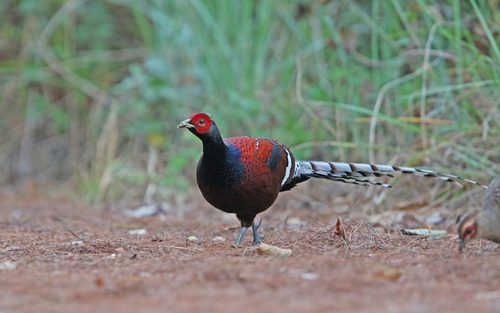
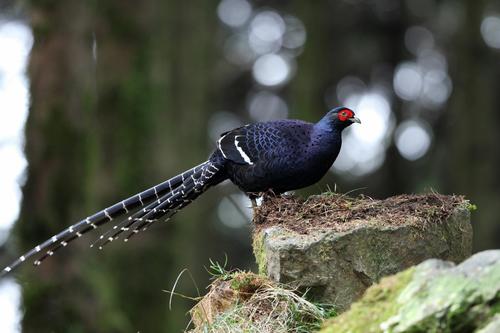
When including the tail, adult males of Syrmaticus mikado reach a maximum body length of 70 centimeters, while smaller females reach up to 47 centimeters. Males have dark plumage that refracts light to produce blue or violet iridescence, with white stripes across their wings and tail. Females are brown, with speckled brown and white quills. The long, striped tail feathers of male Mikado pheasants were historically used as decoration for headdresses by Taiwanese aborigines. The type specimen of this pheasant consists of two of these male tail feathers, which collector Walter Goodfellow obtained in 1906 from the headdress of one of his porters. The species was named to honor the Emperor of Japan, which occupied Taiwan at that time. The Mikado pheasant is endemic to the mountainous regions of Taiwan. It lives in dense shrubs, bamboo growth, and grassy terrain with a conifer overstory in central and southern Taiwan, at elevations between 2000 and 3200 meters above sea level.