About Syringa vulgaris L.
Syringa vulgaris L., commonly known as common lilac, is a large deciduous shrub or multi-stemmed small tree that reaches 6–7 metres (20–23 ft) in height. It produces secondary shoots from its base or roots, with stem diameters reaching up to 20 centimetres (8 in); over decades, this growth can form a small clonal thicket. The tips of its branches may be fasciated. Its bark ranges from gray to gray-brown, being smooth on young stems, and developing longitudinal furrows and flaking texture on older stems.
Its leaves are simple, measuring 4–12 cm (2–5 in) long and 3–8 cm broad. They range from light green to glaucous in color, with an oval to cordate (heart-shaped) form, pinnate venation, a mucronate apex, and an entire margin. Leaves are arranged in opposite pairs, and occasionally grow in whorls of three.
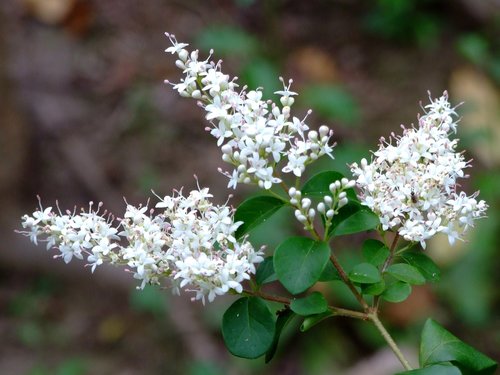
Its flowers have a corolla with a tubular base 6–10 mm long, and an open four-lobed apex 5–8 mm across. Flower color is usually lilac to mauve, and occasionally white. Flowers are arranged in dense, terminal panicles that measure 8–18 cm (3–7 in) long. The fruit is a dry, smooth, brown capsule 1–2 cm long, which splits in two to release two-winged seeds.
This species is native to the southern Balkan Peninsula, where it grows in Serbia, North Macedonia, Bulgaria and adjacent bordering regions, mostly south of the Danube. It naturally grows on rocky hills. Grown in spring for its scented flowers, this large shrub or small tree is widely cultivated and has become naturalized in parts of Europe, Asia, and North America. It is not considered an aggressive species, and is found in the wild across widely scattered sites, usually near past or present human habitations.
Common lilac is a very popular ornamental plant for gardens and parks, valued for its attractive, sweet-smelling flowers that open in early summer, just before many roses and other summer flowers come into bloom. In late summer, lilacs can be attacked by powdery mildew, specifically Erysiphe syringae, a member of the Erysiphaceae family. This species does not develop noticeable fall color, and its seed clusters have no aesthetic appeal.
Common lilac typically blooms heavily in alternate years; this habit can be improved by deadheading flower clusters after their color fades, and before seeds form (few of which are fertile). At the same time, twiggy growth on shoots that have flowered two or more times can be cut back to a strong, outward-growing side shoot. It is widely naturalized in western and northern Europe. As a sign of its full naturalization in North America, it was selected as the state flower of New Hampshire, per the state's wording because it "is symbolic of that hardy character of the men and women of the Granite State".
Breeder Isabella Preston developed a series of hardy S. vulgaris hybrids for Canadian gardens, introducing many later-blooming varieties. These varieties have later-developing flower buds that are better protected from late spring frosts. The resulting Syringa × prestoniae hybrids primarily produce flowers in pink and lavender shades.
The flowers of common lilac are edible, and are used to add flavor to honeys, sugars, food and other sweets.