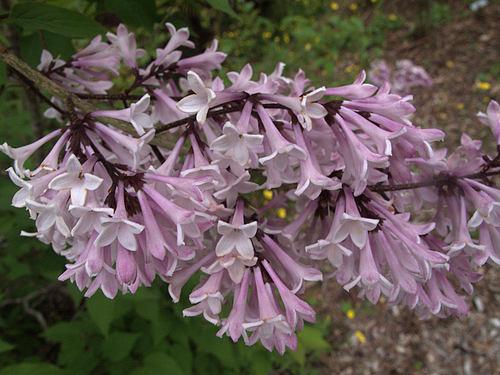
About Syringa pubescens subsp. pubescens
Syringa pubescens is a species of flowering plant in the lilac genus, belonging to the family Oleaceae. It is native to Korea and China, specifically the Chinese provinces of Gansu, Hebei, Henan, Hubei, Jilin, Liaoning, Ningxia, Qinghai, Shaanxi, Shandong, Shanxi, and Sichuan. This plant grows into a substantial deciduous shrub that reaches 6 m (20 ft) tall and wide. It has green leaves that are felted white on the underside, and produces panicles of strongly scented lilac flowers with white throats in early summer. The Latin specific epithet pubescens translates to "downy", which describes the downy texture of the leaves. Three subspecies, previously classified as separate species, are currently recognized: Syringa pubescens subsp. julianae, with the synonym S. julianae; Syringa pubescens subsp. microphylla, with the synonym S. microphylla; and Syringa pubescens subsp. patula (also called Syringa velutina), with the synonym S. patula, commonly known as Korean lilac or Manchurian lilac. The cultivar Syringa pubescens subsp. microphylla 'Superba' has received the Royal Horticultural Society's Award of Garden Merit. Some taxonomic authorities consider Syringa meyeri C.K.Schneid. to be a synonym of S. pubescens, and the cultivar 'Palibin' has also won the Award of Garden Merit. However, plants labeled as S. meyeri have noticeably distinct nearly palmate leaf venation, unlike the pinnate leaf venation found in other forms of S. pubescens.