About Syntomeida epilais Walker, 1854
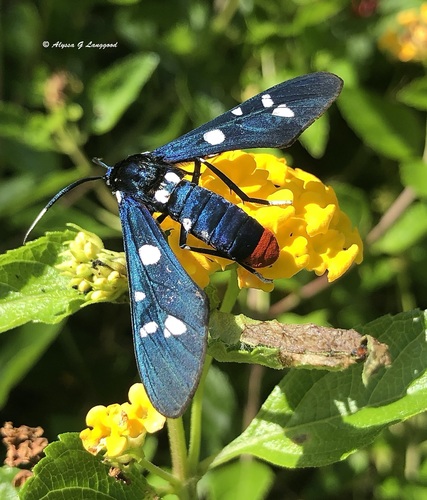
Adult polka-dot wasp moths (Syntomeida epilais Walker, 1854) are dark metallic blue, with white polka dots on their wings and upper abdomen, and a bright red abdomen tip. Their appearance mimics that of dangerous wasps, even though they are completely harmless moths. The species' caterpillars are orange or dark orange with long black hairs that give them a dangerous-looking appearance, but their bristle-like setae do not cause any harm. For reproduction, females attract male polka-dot wasp moths using ultrasonic signals. The signals travel through branches, and males follow the sound to reach the female. Once a male arrives at the female, he emits an answering signal in return. After mating, females seek out a suitable plant to lay their eggs. They lay egg groups of 12 to 75 eggs on the undersides of oleander leaves. The eggs are spherical, pale cream to light yellow in color, and each egg is less than 1 mm in diameter.