About Synthyris bullii (Eaton) A.Heller
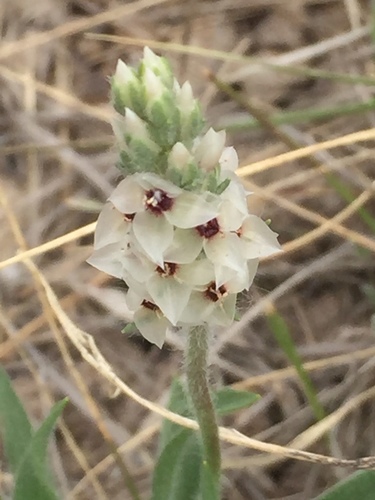
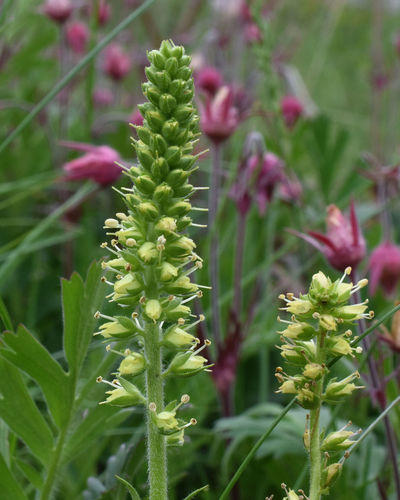
Veronica bullii forms a low-lying rosette of large basal leaves. These basal leaves are covered in fine hairs and have many visible veins. Stem leaves are greatly reduced in size, arranged alternately along the stem, and partially clasp the stems. Yellowish flowers are arranged in a spike: the spike is densely packed during blooming, and becomes well-separated as the plant develops fruit. Each flower is sessile and bilabiate, meaning it has two distinct lips. The lower lip of the flower corolla may be unlobed, or divided into two or three lobes. Two long stamens protrude out past the corolla lobes. Flowering takes place from April through June, and flowering stems persist after flowering until the end of summer. After pollination, the plant develops hairy, two-lobed seed capsules that open at the top once they are ripe. This species is restricted to specific habitats, and prefers gravelly soils found in prairies, grasslands, savannas, and woodlands. Veronica bullii is endemic to the Midwestern region of the United States. It is considered rare or endangered across its entire native range, and is likely extinct in Ohio. Confirmed current populations occur in Indiana, Illinois, Wisconsin, Iowa, and Minnesota. This species is also classified under the scientific name Synthyris bullii (Eaton) A.Heller.