About Synoicus ypsilophorus (Bosc, 1792)
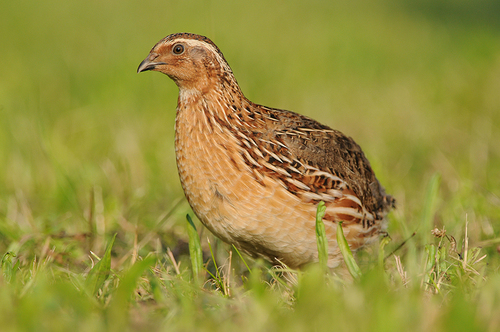
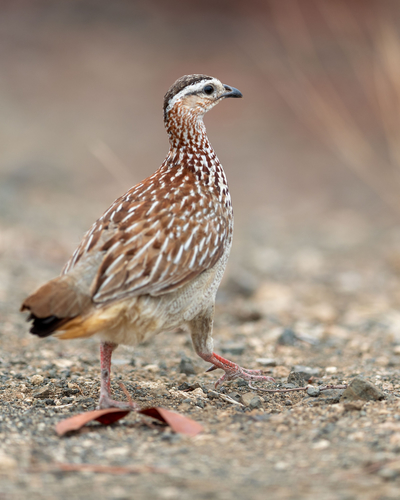
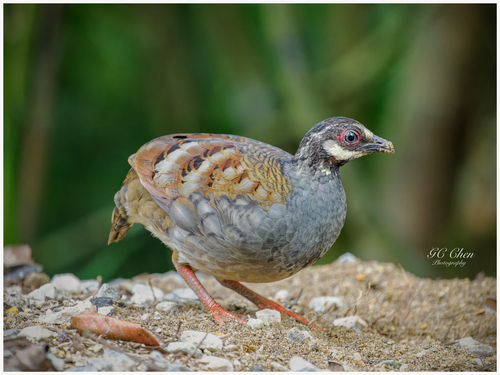
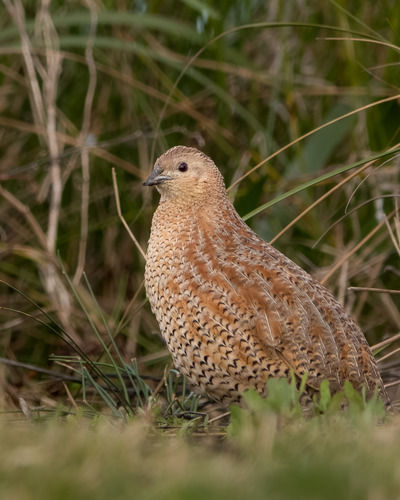
Synoicus ypsilophorus (Bosc, 1792), commonly known as the brown quail, is a plump, stocky bird. Adults grow to 17 to 22 centimetres (6+1⁄2 to 8+1⁄2 in) in length, and weigh between 75 and 140 grams (2+3⁄4 to 5 oz). Its overall colouring varies noticeably across its wide geographic range. Males have reddish-brown plumage speckled with black on the head and upper neck, and are mostly reddish-brown on the back and wings. Their underparts range in colour from buff or rufous to brown, but always display fine black chevron-shaped barring. The tail is short, dark brown with yellowish barring. Females are similar in general appearance to males, but are noticeably paler. Females also have small black spots on the shoulder, and dark chevron-shaped barring across their upperparts. Brown quails produce a range of shrill calls to communicate while moving through dense vegetation; one common call is a double whistle where the second note rises in pitch. This species is found in agricultural areas, wet grasslands, shrublands, spinifex savannah, and freshwater wetlands across most of New Guinea, the Lesser Sunda Islands, as well as northern, eastern, south-eastern and south-western Australia, and Tasmania. It is absent from arid regions. It has been introduced to Fiji and New Zealand. Across its native range, it is mostly a lowland species in Australia, but can be found at elevations up to 1,000 metres (3,300 ft) in New Zealand, and up to 3,700 metres (12,000 ft) in New Guinea. It was first introduced to New Zealand in the 1860s and 1870s, and is now established on the North Island and selected offshore islands. This introduction, along with other quail introductions that did not successfully establish, may have contributed to the extinction of the New Zealand quail, an endemic species that died out shortly after these introductions. One proposed explanation for this demise is that the endemic New Zealand quail lacked resistance to new diseases brought by the introduced brown quail.