About Synoicus chinensis (Linnaeus, 1766)
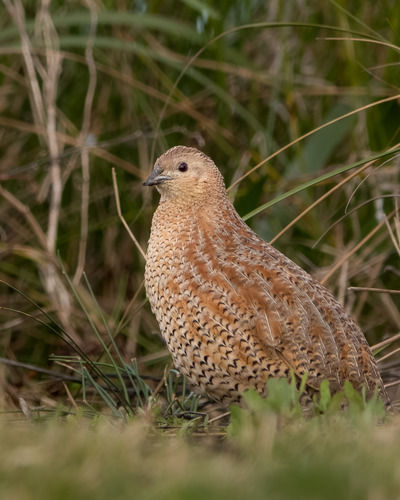
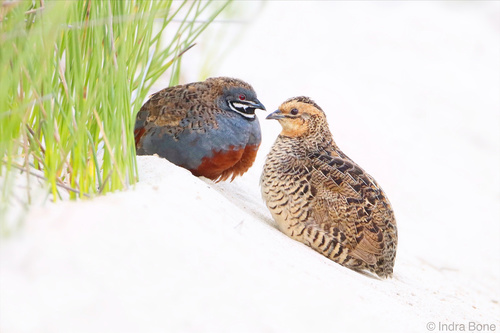
This species, commonly known as king quail, has the scientific name Synoicus chinensis (Linnaeus, 1766). In captivity, male king quail come in a wide range of color mutations, including blue, brown, silver, maroon, dark brown, and nearly black. They have hard orange feet adapted for continuous life on the ground, similar to many other game birds. Females resemble males, but do not have blue color variants. King quail can live up to 13 years in captivity, though most captive individuals live 3 to 6 years. In the wild, their typical lifespan is only 1.5 years. King quail eggs are light creamy brown, slightly pointed at one end, and have a roughly ovular shape. Males produce a descending whistle and a raspy "snoring" call. In the wild, this species ranges from southern China, South Asia, and Southeast Asia to Oceania, reaching as far south as southeastern Australia, and 6 subspecies are currently recognized. In the late 1890s, the Otago Acclimatisation Society made an unsuccessful attempt to introduce this species to New Zealand. The six recognized subspecies are: S. c. chinensis (Linnaeus, 1766), found from India and Sri Lanka to Malaya, Indochina, southeastern China, and Taiwan; S. c. trinkutensis Richmond, 1902, the Nicobar blue-breasted quail, found on the Nicobar Islands; S. c. lineatus (Scopoli, 1786), found in the Philippines, Borneo, the Lesser Sundas, Sulawesi and Sula Islands; S. c. lepidus (Hartlaub, 1879), found in New Guinea and the Bismarck Archipelago; S. c. victoriae (Mathews, 1912), found in eastern Australia; and S. c. colletti (Mathews, 1912), found in northern Australia. This species has a complicated taxonomic history: it was first classified in the genus Coturnix, then moved to Synoicus, then to Excalfactoria. Phylogenetic evidence supports placing it in an expanded Synoicus genus, which alongside the blue quail (S. adansonii) also includes the Snow Mountain quail (S. monorthonyx) and brown quail (S. ypsilophorus). The subspecies S. c. victoriae was formerly named C. s. australis (Gould, 1865), but when the species was reclassified into Synoicus, this name was already in use for the Australian subspecies of brown quail (S. y. australis), so the subspecies epithet was changed to victoriae (Mathews, 1912). For reproduction, males fight to win mating access to females, and the winning male breeds all available females. After mating, females can develop and lay an egg within one to two days. Females either build a nest before laying, or lay their eggs directly on the ground. Females usually only begin incubation once they have laid a full clutch of an ideal size, and clutch size ranges from five to 13 eggs total. All eggs in a clutch are laid before incubation starts. In captivity, the ideal clutch size is six to eight eggs. Chicks hatch approximately 16 days after incubation begins.