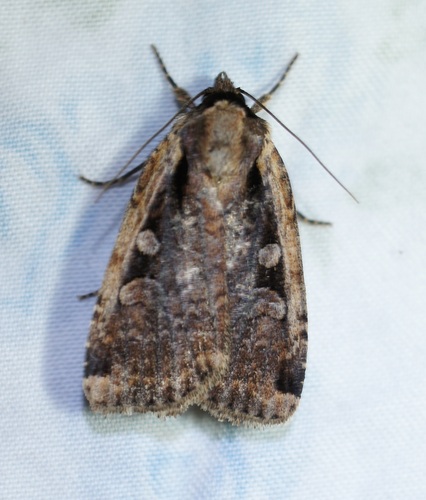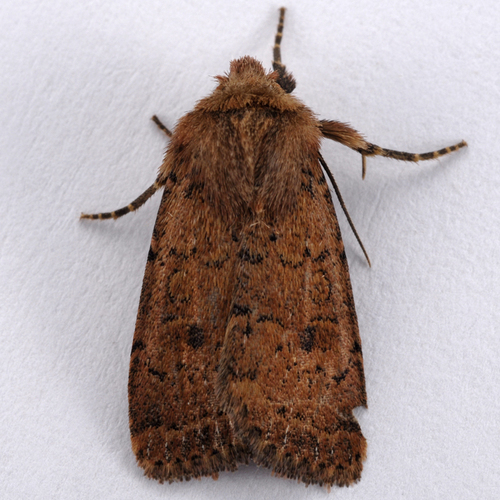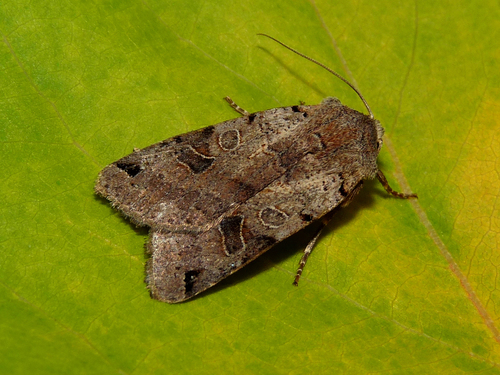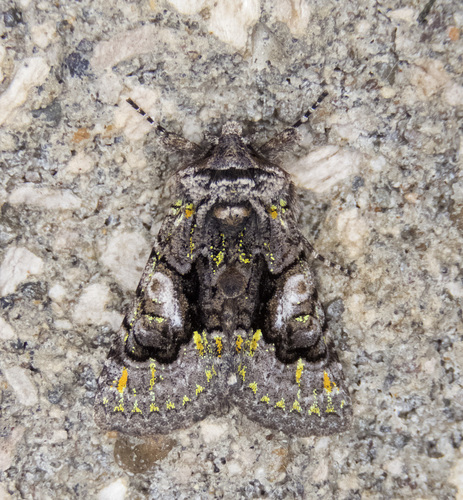
About Syngrapha interrogationis (Linnaeus, 1758)
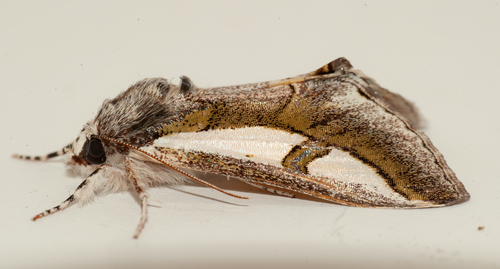
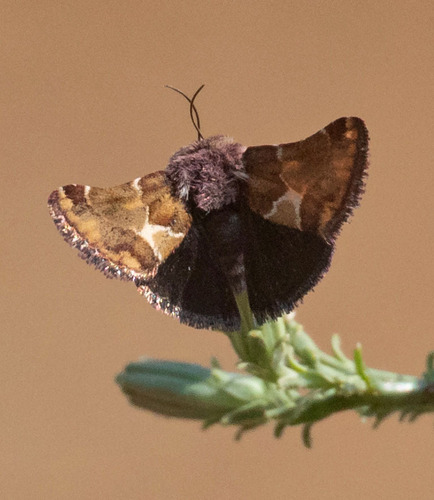
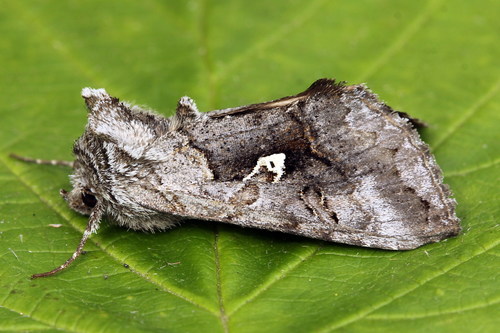
Technical description and variation: The wingspan of Syngrapha interrogationis is 32–38 mm (1.25–1.5 in). The forewing is bright purplish-grey, with black suffusion in the median area and toward the apex. The edges of the stigmata and the lines are lustrous grey; the inner and outer lines are black and double. The inner line is sinuous on the costal half, and forms three small curves across the rest of its length, while the outer line is consistently crenulate throughout. A conspicuous black toothed and indented line precedes the subterminal line, with a blackish cloud toward the apex and a row of pale grey lunules before the terminal marks. The silvery subcellular mark is highly variable across different forms. In the form orbata [Warren], the mark forms a simple loop with a fine silvery edge. In the nominate form, this loop is followed by a small silvery dot. In form flammifera Huene, it is followed by a large round spot that is conjoined to the loop, or rarely separate. In form ignifera [Warren], which is a development of flammifera, the mark is pale yellow (as seen in some flammifera examples) and shaped like a tadpole, with deep fiery red scaling before the postmedian line, beyond the antemedian line, and along the submedian fold. The hindwing is brownish yellow, clouded with darker scales, and has a broad blackish border. The male type specimen from Livonia is held at the Tring Museum in England. The subspecies transbaikalensis Stgr., found in Dauria and East Siberia, is more uniformly bluish grey, with very little black suffusion on the forewing and a paler hindwing; Petersen has also recorded this form from Estonia. Form rosea Tutt, from Scotland, has a rosy ground colour instead of bluish grey. Form cinerea [Warren] has a dull ashy grey ground colour, with almost no dark markings except the subterminal line, and no purplish suffusion; its silvery mark forms a somewhat triangular loop. The Tring Museum holds three examples of this form from Cedre, Hautes-Pyrénées. The museum also holds another grey form from Cauterets in the Pyrenees that strongly resembles cinerea, but has a complete silvery gamma mark and somewhat more developed dark shades; this specimen represents form gammifera [Warren]. These last two grey forms may constitute a separate species distinct from S. interrogationis.