About Syndactyla subalaris (P.L.Sclater, 1859)
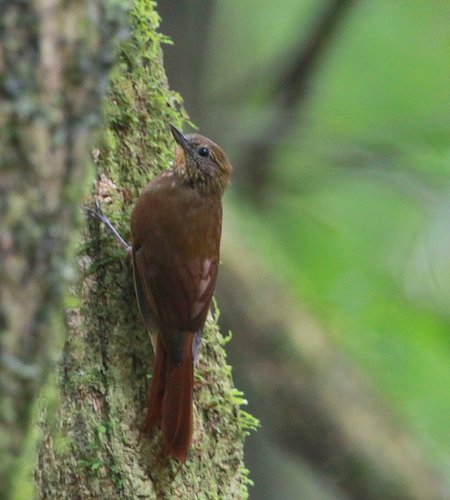
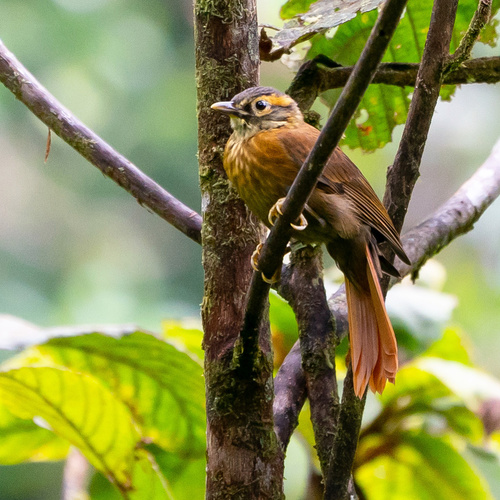
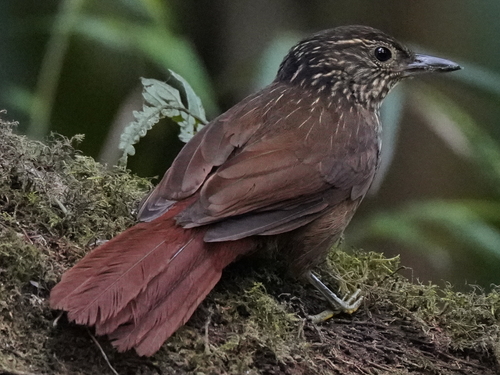
The lineated foliage-gleaner, Syndactyla subalaris (P.L.Sclater, 1859), is 17 to 19 cm (6.7 to 7.5 in) long and weighs 26 to 40 g (0.92 to 1.4 oz). Males and females have identical plumage. Adults of the nominate subspecies S. s. subalaris have a discontinuous light buff supercilium that reaches the nape. The rest of their face is blackish brown with small buff markings. Their crown is dark brown with thin buff streaks. They have a narrow, ill-defined darker brown collar with wide buff streaks. Their back is rich dark brown with long thin buff streaks, their rump is plain rich dark brown, and their uppertail coverts are dark brown with chestnut tips. Their tail is dark chestnut, and their wings are rich dark brown with light rufescent brown at the bend. Their throat is buff with blurry brownish streaks, their breast is dark brown with buff streaks, their belly and flanks are a slightly paler brown with thinner streaks that fade toward the rear, and their undertail coverts are this same paler brown with wider ochraceous streaks. Their iris is brown to dark brown, their maxilla is dark brown to black, their mandible ranges in color from grayish horn to ivory, and their legs and feet are olive-green to greenish gray. Juveniles are generally brighter overall than adults, with a blacker cinnamon-streaked crown, a more reddish brown back, black speckles on the chin, a more ochraceous cinnamon supercilium, neck, and breast, richer brown flanks, and cinnamon-brown undertail coverts. Several other subspecies have distinct features. S. s. lineata has a paler but more rufescent back than the nominate, a heavily marked buffy yellow throat, and slightly more olivaceous underparts with thinner streaks. S. s. tacarcunae is similar to lineata, but has a darker more olive-brown back, a paler more yellowish throat, and grayer underparts. Compared to the nominate, S. s. striolata has a slightly darker and less rufescent crown with heavier buff streaks, wider streaks on the back, less rufescent wings, a paler and less buffy throat, and wider and more extensive streaks on the underparts. S. s. olivacea has a more blackish brown crown than the nominate and the most olivaceous underparts of all subspecies. S. s. mentalis has a blacker crown than the nominate, more conspicuous streaks on the crown and nape, a darker and more buffy yellow throat, and slightly more rufescent underparts with stronger streaks. The lineated foliage-gleaner has a disjunct distribution, with each subspecies occupying a separate range. S. s. lineata is found in the mountains of Costa Rica and extends into western Panama as far as Veraguas Province. S. s. tacarcunae is found in Serranía del Darién, from extreme eastern Panama into northwestern Colombia. S. s. subalaris ranges from Colombia's Western Andes, the western slope of its Central Andes, and its isolated Serranía de San Lucas, south through western Ecuador to El Oro Province. S. s. striolata occurs in Colombia's Eastern Andes and the Andes of western Venezuela. S. s. olivacea is found in southwestern Táchira state in western Venezuela. S. s. mentalis ranges from eastern Ecuador south into Peru as far as the Department of Junín. This species inhabits evergreen forest in the subtropical and foothill zones of its mountain ranges, and especially favors stream-side areas with dense undergrowth. In elevation, it mostly occurs between 1,000 and 2,300 m (3,300 and 7,500 ft), but is found locally as low as 600 m (2,000 ft) and reaches as high as 2,800 m (9,200 ft) in Colombia.