About Synallaxis erythrothorax P.L.Sclater, 1855
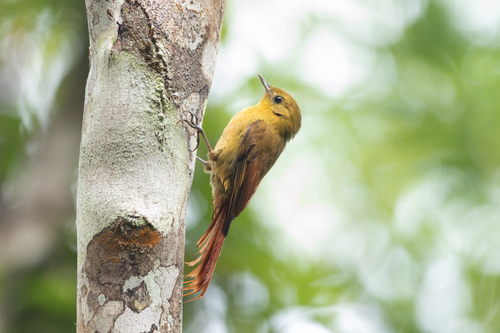
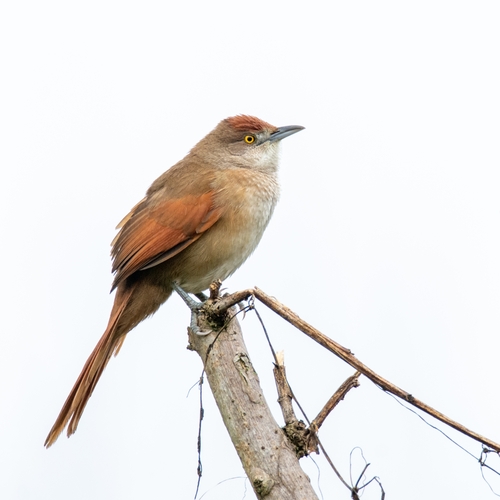
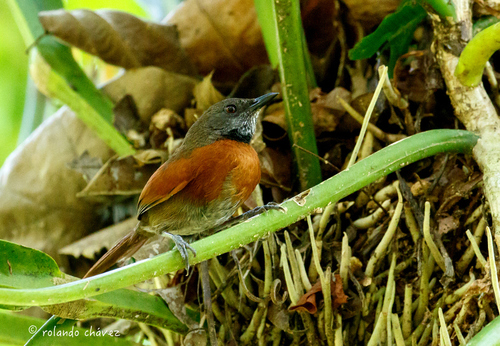
The rufous-breasted spinetail, scientific name Synallaxis erythrothorax P.L.Sclater, 1855, is 13 to 16 cm (5.1 to 6.3 in) long and weighs 15 to 19 g (0.53 to 0.67 oz). Males and females have identical plumage. Adults of the nominate subspecies have sepia brown faces, crowns, napes, backs, rumps, and uppertail coverts. Their wings are chestnut, with brown tips on their flight feathers. Their tails are chestnut brown, and each tail feather has a black shaft. Their chin and upper throat are slate black with relatively wide white streaks, while their lower throat is solid slate black. Their breast and sides are deep cinnamon rufous, their flanks are light brown, their belly is mottled whitish or mouse gray with an olive tinge, and their undertail coverts are a lighter, grayer brown than the flanks. Their irises are dark red to reddish brown, their bills are black (sometimes with a brownish base to the lower mandible), and their legs and feet are bright gray to greenish gray. Juveniles follow a similar pattern to adults, but have light brown upper breasts, flanks, and undertail coverts, with pale grayish lower breasts and bellies that are mottled with brown. The subspecies S. e. pacifica is overall paler than the nominate subspecies, has a gray lower throat rather than black, and has less olive coloration on its flanks. The rufous-breasted spinetail has a disjunct distribution. The nominate subspecies is the more widespread of the two; it occurs from Veracruz, northern Oaxaca, and the Yucatán Peninsula in Mexico, south along the Caribbean slope through Belize and Guatemala into northwestern Honduras. Subspecies S. e. pacifica occurs from southwestern Chiapas in Mexico, south along the Pacific slope through Guatemala into El Salvador. This species lives in a variety of landscapes that all feature dense vegetation, including lowland evergreen forest edges, secondary forest, second-growth scrublands, brushy clearings, and swampy areas. In terms of elevation, it ranges from sea level up to 1,250 m (4,100 ft) in Guatemala, but only reaches 750 m (2,500 ft) in the rest of its range.