About Synallaxis albescens Temminck, 1823
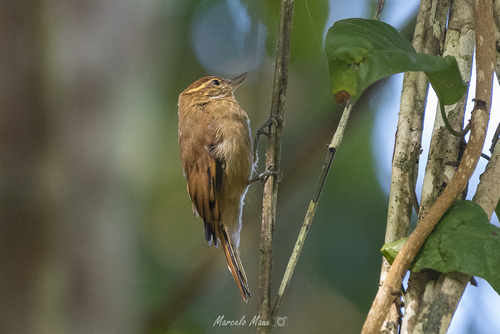
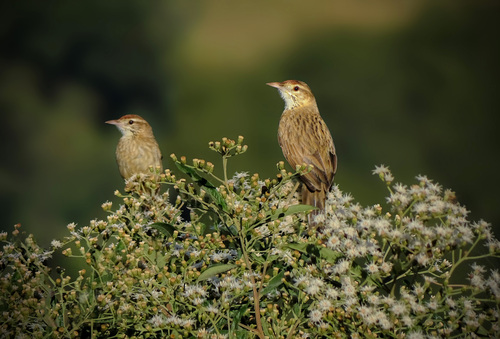
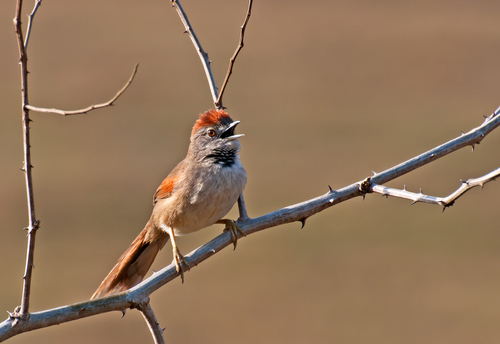
The pale-breasted spinetail (Synallaxis albescens Temminck, 1823) measures 13 to 16 cm (5.1 to 6.3 in) in length and weighs 9 to 17 g (0.32 to 0.60 oz). It is slightly smaller and has a shorter bill than most other species in the genus Synallaxis. Males and females have identical plumage. Adult individuals of the nominate subspecies S. a. albescens have a pale brownish gray face, with an even paler line running through the eye. Their forehead is olive grayish brown, and their crown is dark rufous, often with faint mottling. Their back, rump, and uppertail coverts are olive-brown. Their wing coverts are rufous, and their flight feathers are tawny-brownish. Their tail is olive-brown with a variable rufescent tint on the outer feathers; the tail is graduated, and its feathers have somewhat pointed tips. Their throat is whitish, with black flecks on its lower portion. Their breast is pale buffy gray, their belly is an even paler buffy gray, and their flanks and undertail coverts are browner than the belly. Their iris ranges from yellowish to light brown or brown; their maxilla is black to dark gray, their mandible is blackish to gray (the gray mandible sometimes has a dark tip), and their legs and feet are yellowish brown to grayish olive or brownish yellow. Juveniles have a brownish gray crown. Compared to adults, juveniles have paler, more rufescent upperparts, an almost white throat, and paler underparts with an almost white center to the belly. The other 10 subspecies of pale-breasted spinetail differ from the nominate subspecies and from each other as follows: S. a. latitabunda is darker than the nominate, with a browner tail and browner flanks. S. a. insignis has more extensive gray on the forehead and a smaller rufous crown than the nominate, along with a paler, brownish-tinged back and a paler, less grayish breast. S. a. occipitalis is darker than the nominate and has a blackish forehead. S. a. littoralis has more brownish upperparts than insignis and less grayish underparts than the nominate. S. a. perpallida is darker than the nominate, with more grayish upperparts, a darker rufous crown and darker rufous wing coverts, and a very white belly. S. a. nesiotis has a paler crown and paler shoulders (with a yellowish tinge) than the nominate, along with paler, grayer upperparts and whiter underparts. S. a. trinitatis has a darker crown and darker wing coverts, and a more buff-brown back than the nominate. S. a. josephinae is darker than nesiotis, with a darker face, a less buffy back, a more grayish breast, and darker brownish flanks. S. a. inaequalis is much paler than josephinae, with lighter rufous crown and lighter rufous wing coverts, a grayish-tinged back, whiter throat and belly, and pale gray to whitish breast. S. a. australis is similar to the nominate, with olive tips on the crown feathers and a duller, more grayish brown back. Subspecies of the pale-breasted spinetail have the following distributions: S. a. latitabunda is found in southwestern Costa Rica and the Pacific coasts of southern Panama and northwestern Colombia. S. a. insignis is found in northern and central Colombia and Venezuela's Apure state. S. a. occipitalis is found in the mountains of north-central Colombia and northwestern Venezuela. S. a. littoralis is found in coastal northern Colombia. S. a. perpallida is found on Colombia's Guajira Peninsula and in far northwestern Venezuela. S. a. nesiotis is found from Colombia's Sierra Nevada de Santa Marta east into northern Venezuela, and also on Isla Margarita. S. a. trinitatis is found in Trinidad and eastern Venezuela. S. a. josephinae is found in southern Venezuela, Guyana, Suriname, and northern Brazil's Roraima state. S. a. inaequalis is found in French Guiana and north-central and northeastern Brazil. S. a. albescens is found in eastern and southern Brazil from Maranhão and Pernambuco to Mato Grosso and Paraná, eastern Paraguay, and northeastern Argentina's Misiones Province. S. a. australis is found in southeastern Peru's Department of Madre de Dios, central and eastern Bolivia, Paraguay, Argentina south to La Pampa and Buenos Aires provinces, and western Uruguay. The pale-breasted spinetail lives in a wide variety of open grassy landscapes. These include savanna, cerrado, campo rupestre, shrub-steppe, brushy areas within woodlands, pastures, and the edges of secondary forest, marshes, and roadsides. In general, it is found at elevations below 1,500 m (4,900 ft). In Central America it occurs below 1,250 m (4,100 ft), and in Colombia it can be found up to 1,800 m (5,900 ft).