About Symphytum tuberosum L.
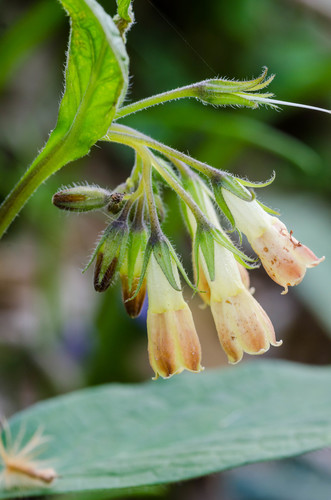
Tuberous comfrey, Symphytum tuberosum L., flowers from April to June. It can also reproduce asexually via vegetative growth using rhizomes, which let it spread from its original site to colonize new areas and compete as it grows. This vegetative spread continues into autumn, when young clonal plants are visible while the parent plant's leaves break down and rot. This very hardy species survives northern winters well. Both its stems and leaves are covered in soft hairs, and its leaves have deep, distinct veins. Leaf size is distinctly reduced from the top of the plant to the base, and the stem usually stays unbranched. Its flowers are a subtle pale creamy yellow, a key feature that distinguishes it from purple-flowered Russian Comfrey. Common pollinators of this species are the common carder bumble bee, honey bee, and red mason bee.
This species is distributed across the whole of Europe. In Great Britain, it is naturally less common in the south; distribution maps show it is common in Scotland, and present but uncommon across most of England and Wales. Thanks to planting, it now has a well-established, wide distribution on the Isle of Skye, and this introduced establishment has also occurred in Ireland. A number of introduced sites of S. tuberosum exist on the west coast of North America.
Vernacular common names like 'knitbone' reflect the historical role of tuberous comfrey and various hybrid comfreys in traditional herbal medicine. Traditional medicinal recipes use both the leaves and roots of this plant: leaves are applied directly to damaged skin under a compress to speed up healing of minor abrasions.
In culinary use, fresh young leaves harvested in spring can be used as an herb in cooked recipes. However, they are not eaten raw due to their hairy texture and mildly toxic properties. After preparation, roasting until brown and brittle, and grinding into a powder, the root can be used as a palatable, non-acidic alternative to coffee, similar to dandelion root.