About Symphytum officinale L.
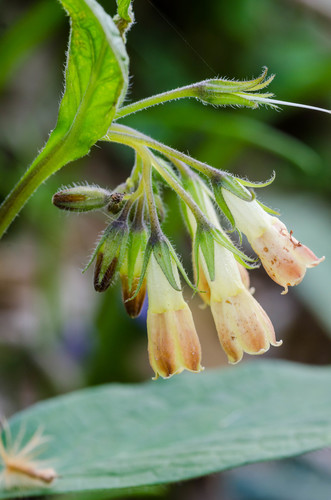
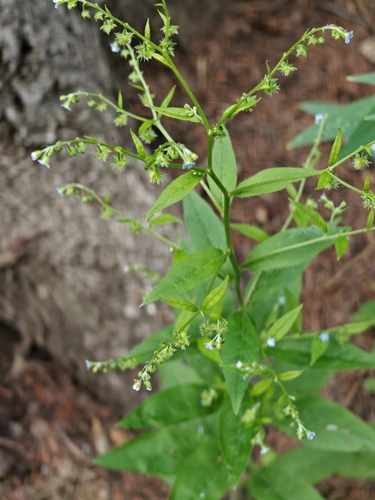
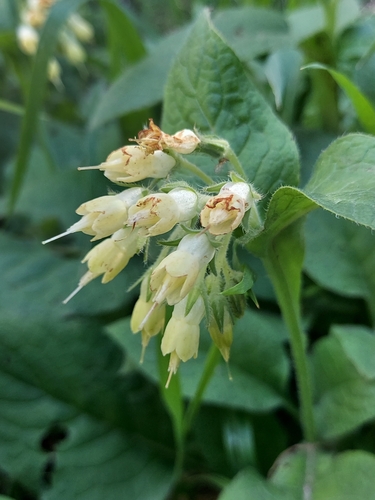
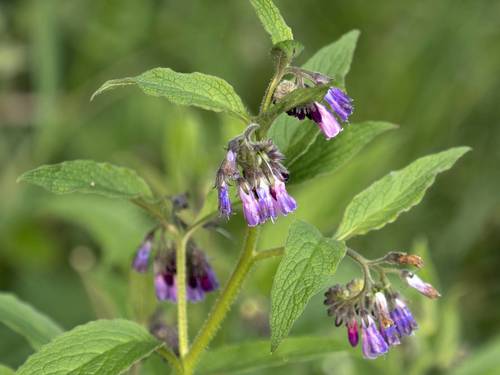
Symphytum officinale L., commonly known as comfrey, is a perennial herb that grows 0.3 to 1.5 metres (1 to 5 ft) tall. It has branched, strongly winged stems, and a distinct taproot that can reach up to 1.8 m deep; the roots are white internally, and covered in black outer bark. Above-ground parts of the plant are covered in long, downward-pointing, tapering hairs, which are bristly on stems and softer on leaves. Large, simple, mostly stalked leaves grow in an alternate pattern along the erect stems; they are oval-lanceolate in shape, ranging from 4 to 25 centimetres (1+1⁄2 to 10 in) long. Leaves in the upper portions of the stem are narrower, lack stalks, and have margins that extend down the stem. Recorded chromosome counts for this species are 2n = 24, 26, 36, 40, 48 or 54. Comfrey is distributed across western Asia, Europe, and North America, where it grows in moist grasslands, along riverbanks, and in ditches. It is cold hardy down to −35 °C (−31 °F) and drought tolerant. Comfrey is mildly toxic. Like most members of the Boraginaceae family, it contains pyrrolizidine alkaloids: toxic compounds that are readily absorbed through the stomach or skin, and may increase the risk of fatal liver toxicity. In 2001, the US Food and Drug Administration and Federal Trade Commission banned the sale of comfrey products for internal use and use on open wounds due to these potential toxicities. A 2018 review of pyrrolizidine alkaloids found in comfrey noted widespread potential toxicity to humans and livestock, while also identifying potential opportunities for drug development from these compounds. Despite its toxicity, comfrey leaves and shoots have been considered edible, even when raw. Stalks are said to be best collected before flowering, blanched, and then steamed, and leaves may also be used to make tea. In traditional folk medicine, Symphytum officinale roots have been used internally as herbal tea or tincture, or externally as ointment, compresses, or alcoholic extract, to treat a range of disorders. English herbalist John Gerard (1545–1612) recorded that "the slimie substance of the roote made in a possett of ale" helped relieve back pain. Poultices made from comfrey have been used with the intended purpose of healing broken bones, which gave the plant its common nickname "knitbone". A 2013 review of clinical studies investigating comfrey's possible effects on osteoarthritis found that the quality of existing research was too low to draw conclusions about the product's efficacy and safety. As of 2015, there were no comfrey products approved for oral use in Europe, and topical comfrey products sold to treat bruises or joint pain were assessed to carry a risk of liver toxicity.