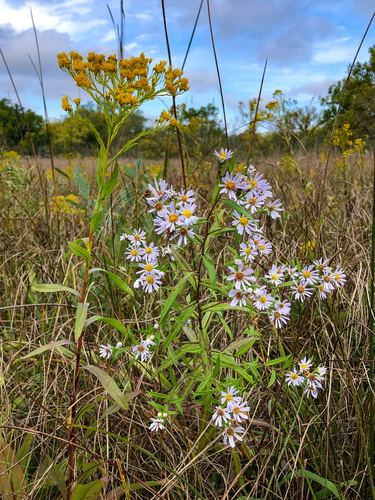
About Symphyotrichum praealtum (Poir.) G.L.Nesom
Symphyotrichum praealtum, also commonly called willowleaf aster, is a perennial herbaceous plant that grows from long rhizomes. Its thick, firm leaves have noticeable net-like venation on their undersides. Flowering takes place between August and November, and by this period, the plant's lower leaves are often withered. Dense clusters of flower heads grow on the branched upper section of the stem. The ray florets are pale violet or lavender, while the disc florets are cream or pale yellow. Willowlfeaf aster is native to most of eastern and central United States, the Mexican states of Chihuahua, Coahuila, and Nuevo León, and the far southern part of Ontario, Canada. It has been introduced to central Europe. This species grows in moist open habitats, which include wet prairies, meadows, shores, oak savannahs, ditches, and roadsides. Open habitats suitable for Symphyotrichum praealtum require periodic disturbance, such as wildfire, drought, or clearing by humans, to stay suitable. Symphyotrichum praealtum spreads through its rhizomes to form large clonal colonies. This species cannot self-pollinate, and cross-pollination with a genetically distinct individual is necessary to produce seeds. Its seeds are dispersed by wind. In some regions, Symphyotrichum praealtum may be the plant that flowers latest in the season, which can reduce the number of available insect pollinators for the species.