About Symphyotrichum novae-angliae (L.) G.L.Nesom
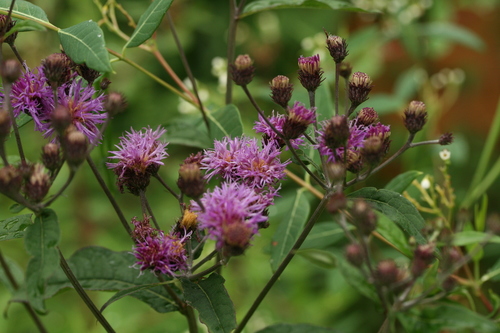
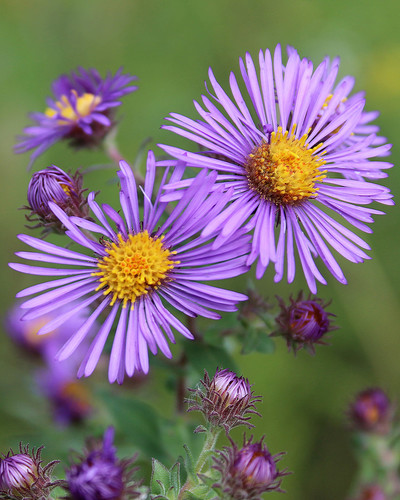
Symphyotrichum novae-angliae, commonly called New England aster, is a clump-forming herbaceous perennial plant. It typically grows 30 to 120 centimeters (1 to 4 feet) tall and 60 to 90 centimeters (2 to 3 feet) wide, and may occasionally reach heights of 180 to 240 centimeters (6 to 8 feet). It is cespitose, meaning it grows in clumps with several erect stems emerging from a single point. Its stems are stout and mostly unbranched. Upper stems, leaves, and some parts of the flower heads are covered in tiny stipitate glands (glands borne on small stalks).
S. novae-angliae grows in a wide range of open, typically moist habitats, including meadows, prairies, marshes, fens, forest edges, and disturbed human-created sites such as roadsides and former agricultural fields. In its native range, it grows mostly in moist calcareous soils, and favors marshier, wetter sites in the westernmost part of its range. It is rated Facultative Wetland (FACW) on the United States National Wetland Plant List for all wetland regions, which means it usually grows in wetlands, but does not require wetlands to grow. For example, it has been recorded growing on dry, sandy soils on the Niagara Peninsula in southern Ontario. It grows best in soils with a pH between 5 and 7.
Coefficients of conservatism (C-values) for Symphyotrichum novae-angliae in Floristic Quality Assessment (FQA) range from 0 to 8, depending on the evaluation region. Higher C-values indicate lower tolerance to disturbance and a higher likelihood that the population grows in a presettlement natural community. For instance, in the Dakotas, S. novae-angliae has a C-value of 8, meaning its populations there occur in high-quality remnant natural areas with little environmental degradation, though it can tolerate some periodic disturbance. In contrast, for the Atlantic coastal pine barrens of Massachusetts, New York, and Rhode Island, it has a C-value of 1, meaning its presence in this ecoregion gives little to no confidence that the site is a remnant habitat.
Symphyotrichum novae-angliae reproduces sexually through wind-dispersed seeds, and asexually (vegetatively) through short rhizomes. The species is largely unable to self-pollinate, and requires cross-pollination to produce seeds. In the Symphyotrichum genus, ray florets are exclusively female, each having a pistil and no stamen, while disk florets are androgynous, with both male and female reproductive parts.
The seeds of S. novae-angliae are an important fall and winter food source for songbirds. A wide variety of generalist nectar-feeding insects visit the plant, including butterflies, moths, ants, flies, and bees. It is heavily visited by long-tongued bumblebees, such as the golden northern bumble bee (Bombus fervidus) and the half-black bumblebee (Bombus vagans), and visited less often by short-tongued bee species. Some bees, including the broad-handed leafcutter bee (Megachile latimanus) and Drury's long-horned bee (Melissodes druriellus), collect pollen as well as nectar from the plant.
Symphyotrichum novae-angliae has been used for a variety of medicinal purposes. In his 1828 work Medical Flora, French botanist Constantine Samuel Rafinesque noted its use to treat skin eruptions, including urushiol-induced contact dermatitis caused by poison ivy and poison sumac, writing: "The A. novanglia is employed in decoction internally, with a strong decoction externally, in many eruptive diseases of the skin: it removes also the poisonous state of the skin caused by Rhus or Shumac." Among Indigenous peoples of North America, documented uses include the following: The Cherokee made a poultice of the roots for pain, an infusion of the roots for diarrhea, an infusion of the plant for fever, and sniffed root ooze for catarrh. Both the Meskwaki and the Potawatomi used the plant to revive unconscious people: the Meskwaki via smudging, and the Potawatomi via fumigation. The Iroquois made a decoction of the plant for weak skin, and a decoction of the roots and leaves for fevers; they also used the plant as a love medicine. Both the Mohawk people and the Iroquois used an infusion of the whole plant combined with rhizomes from another plant to treat mothers with intestinal fevers. The Ojibwe smoked the root in pipes to attract game.