About Symphyotrichum lanceolatum (Willd.) G.L.Nesom
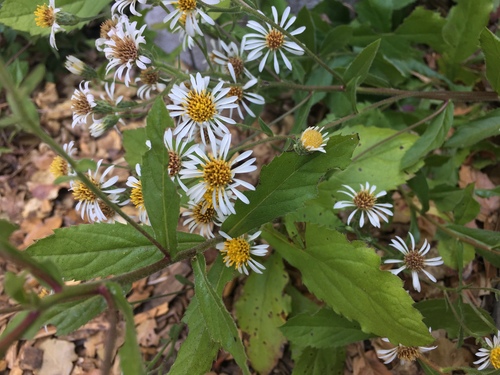
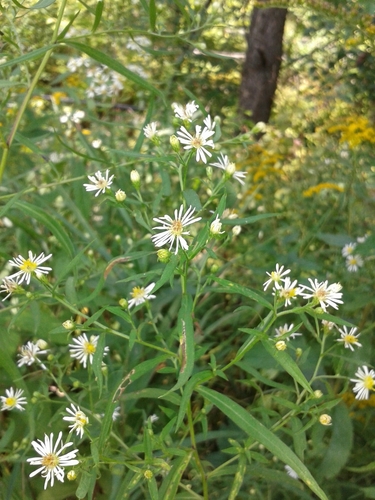
Symphyotrichum lanceolatum, commonly called panicled aster, grows from a rhizome and produces a thick, erect stem that can reach 1.5 meters (5 feet) tall or more, sometimes growing close to 2 meters (6+1⁄2 feet) in height. Its leaves are generally hairless, though the upper surface may feel slightly rough to the touch due to tiny bristles. Leaf blades have winged petioles, and their bases may sheath the stem. The largest leaves, located near the base of the plant, grow up to around 15 centimeters (6 inches) long. Leaves positioned higher on the stem are smaller, and lower leaves may have toothed edges. S. lanceolatum blooms from July to October. Its inflorescence is usually a large, branching panicled array holding many flower heads of varying sizes. Each flower head contains many tiny florets grouped together to look like a single flower. Each head holds 16 to 50 ray florets, each 3–14 millimeters (1⁄8–1⁄2 inch) long, that are white, sometimes with a pink or purple tinge. There are roughly 20 to 40 disk florets per head, which open yellow and later turn purple. Each disk floret has five lobes that may spread out when open. In its native range, Symphyotrichum lanceolatum may be a minor weed in agricultural fields. In addition to dispersal through wind-blown seed, it spreads extensively via rhizomes to form large clonal colonies. While these clones do not dominate habitats in North America, where they grow alongside grasses, goldenrods, and other asters, S. lanceolatum is an invasive species in Europe that crowds out native plants in riparian habitats. This invasiveness has been linked to allelopathic compounds found in S. lanceolatum tissue and their effects on native European plants. Viable seed production appears to be limited in Europe, so the species spreads there mostly through rhizomes. The species is visited by a wide range of late-season pollinators and nectar-seeking insects, including bees, hoverflies, other flies, moths, and wasps. Cross-fertilization is typically required to produce viable seed, which means large clonal colonies often have low seed production. Within its native range, indigenous peoples have used Symphyotrichum lanceolatum for various medicinal purposes: the Zuni people of the American Southwest use S. l. var. hesperium to treat wounds and nosebleeds, and the Iroquois in what is now eastern Canada use S. l. var. lanceolatum to treat fever.