About Symphyotrichum divaricatum (Nutt.) G.L.Nesom
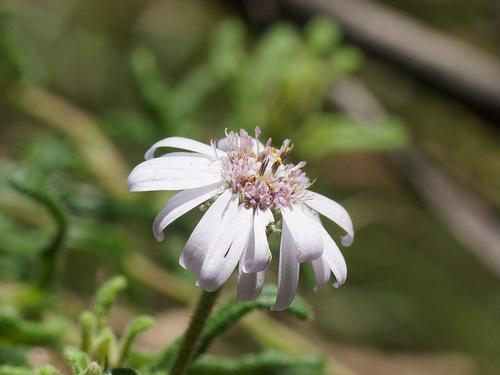
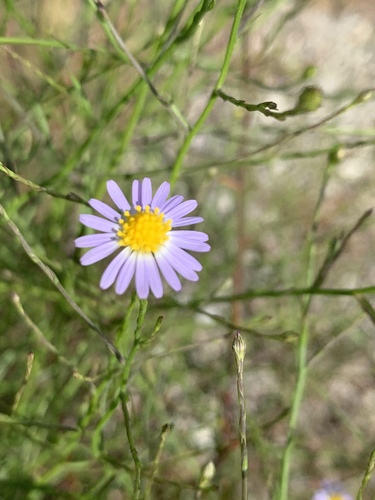
Symphyotrichum divaricatum is an annual herbaceous plant with a taproot. It typically grows between 60 and 200 centimeters (2 to 6 and 1/2 feet) tall, but specimens can be as short as 10 centimeters (4 inches). Its stems are green, usually simple, and sometimes produce lower branches. Stems are hairless, often with purple or brownish discoloration; small hairs may be present at the points where leaves attach to the stem. Its leaves are thin, hairless, and range in color from green to dark green. The species usually flowers from July to November, and flowering may sometimes continue into February. It has lavender to blue ray florets that surround yellow disk florets. As the plant dries after pollination, each individual ray floret curls under into 3 to 5 coils. Symphyotrichum divaricatum is native to the Mexican states of Baja California Sur, Chihuahua, Coahuila, and Tamaulipas, and the U.S. states of Alabama, Arkansas, Kansas, Louisiana, Mississippi, Nebraska, New Mexico, Oklahoma, Tennessee, Texas, and Virginia. It has been introduced to Colombia and the U.S. state of New York. It grows in marshy habitats, roadsides, lawns, and waste places at elevations between 0 and 1,500 meters (0 to 4,921 feet), and is often considered a weedy species.