About Symphodus rostratus (Bloch, 1791)
Physical Description
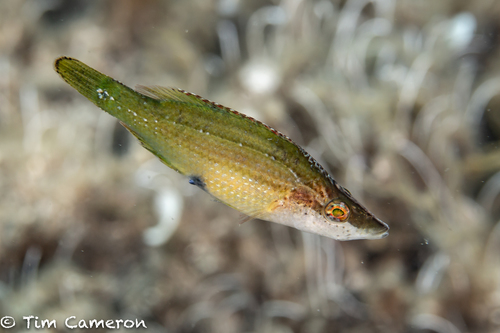
The pointed-snout wrasse, scientifically named Symphodus rostratus (Bloch, 1791), is a slender wrasse species with a small head and an elongated, pointed snout. It has a long dorsal fin, with 14–16 spines in the anterior portion and 9–12 branched rays in the posterior part. Its short anal fin has 3 spines and 9–11 branched rays.
Coloration and Markings
The fish's body is covered in large scales, and is overall green or brownish, with darker markings on the flanks and back. It normally has a white stripe on the head that runs from the snout to the base of the dorsal fin. A four-year-old specimen was measured at a standard length of 10.3 centimetres (4.1 in). Males develop brighter coloration during the breeding season.
Distribution and Habitat
The pointed-snout wrasse is distributed across all coastal waters of the Mediterranean Sea, and also occurs in the western Black Sea. It inhabits areas near rocks in eelgrass beds of Zostera and Posidonia, at depths between 1 and 30 meters (3.3 to 98.4 ft), and lives in small groups.
Feeding Adaptations
It feeds on small benthic organisms including molluscs, crustaceans, and echinoderms; its distinctive snout shape is thought to be a special adaptation for picking prey out of crevices.
Reproductive Behavior
Spawning takes place in spring: males build nests from plant material and guard them, and one or more females lay adhesive eggs into the nest. This species reaches sexual maturity at one year old, and has a total lifespan of 3–4 years. Males grow faster than females.
Juvenile Development
After hatching, young pointed-snout wrasses feed on plankton for their first few weeks of life.