About Sympetrum sanguineum (Müller, 1764)
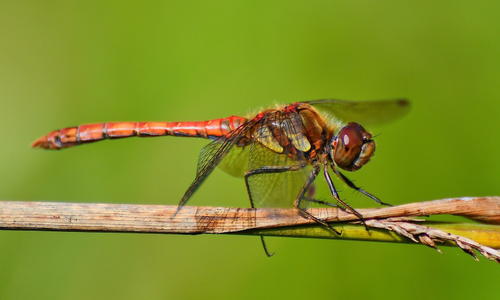
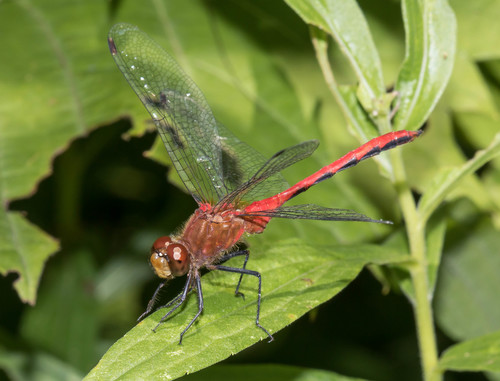
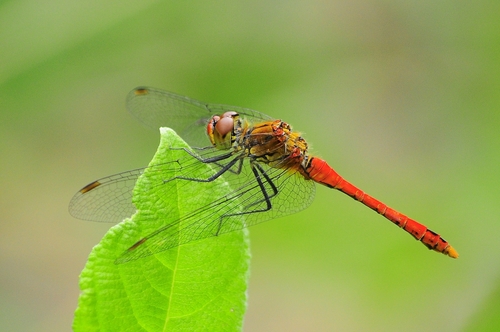
The ruddy darter (Sympetrum sanguineum) has a body length of 34–36 millimetres (1.3–1.4 in) and a maximum wingspan of 6 cm (2.4 in). These dragonflies are smaller than the common darter. They have entirely black legs, their wings bear a brown pterostigma, and the base of the wings is orange. Two clear black marks are present on segments S8 and S9 of the abdomen. The head, thorax, and abdomen of mature males are a vivid red, while females are slightly smaller, golden-yellow with black markings. Males develop their characteristic blood-red color as they mature, along with a red frons and red-brown thorax. The abdomen widens along its final third of length, and has a distinct pinched section where it connects to the thorax. The all-black legs of the ruddy darter separate it from the otherwise very similar common darter (Sympetrum striolatum) and vagrant darter (Sympetrum vulgatum), both of which have yellow stripes on their legs. The spotted darter (Sympetrum depressiusculum), which also has all-black legs, has a noticeably more club-shaped abdomen and brighter pterostigmata. The ruddy darter occurs in temperate regions across Europe, ranging east as far as Siberia and south as far as the northern Sahara. Its conservation status is considered secure; populations appear to be increasing in some areas, such as central England, and it is spreading northward at its northern limit in northeastern England. It has been recorded in Albania, Algeria, Armenia, Austria, Azerbaijan, Belarus, Belgium, Bosnia and Herzegovina, Bulgaria, Croatia, Cyprus, Czech Republic, Denmark, Estonia, Finland, France, Germany, Greece, Hungary, Ireland, Italy, Kazakhstan, Kyrgyzstan, Latvia, Liechtenstein, Lithuania, Luxembourg, the former Yugoslav Republic of Macedonia, Moldova, Monaco, Montenegro, Morocco, Netherlands, Norway, Poland, Portugal, Romania, Russian Federation, Serbia, Slovakia, Slovenia, Spain, Sweden, Switzerland, Tajikistan, Tunisia, Turkmenistan, Ukraine, United Kingdom, and Uzbekistan. This species typically prefers still bodies of water that host semi-aquatic vegetation such as rushes and reeds. Ruddy darters can be seen in their active range between the months of June and November. Mating occurs while the pair is in flight, and the connected pair flies in dipping motions over the water. The female releases her fertilized eggs onto the water surface through alternating abdominal movements. The male often hovers nearby during this process, guarding the female by chasing away any other approaching males. Larvae live under the water surface for one year before emerging and pupating to become adults.