About Sympetrum fonscolombii (Selys, 1840)
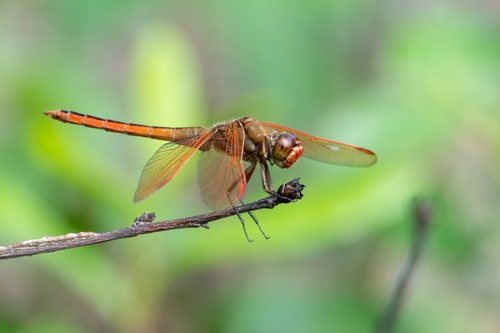
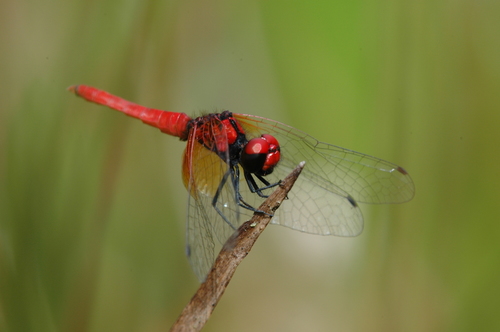
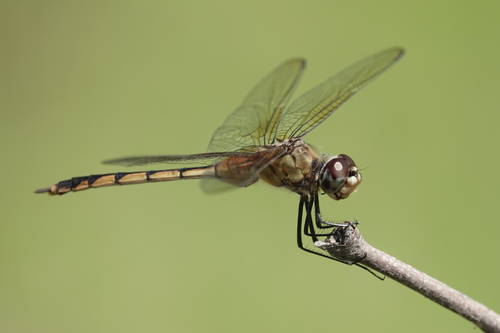
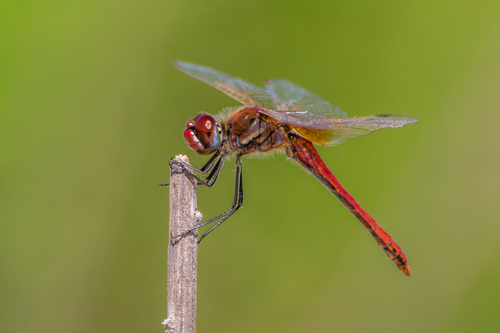
For identification, Sympetrum fonscolombii reaches a body length of 38–40 millimeters, or 1.5–1.6 inches. This species looks similar to other Sympetrum species, but a clear view through binoculars allows for positive identification, especially for male individuals. Males have a red abdomen that is redder than the abdomens of many other Sympetrum species. Their frons and thorax are red-brown. Their eyes are brown on the upper half and blue or grey on the lower half. Their wings have red veins, and the wing bases of their hindwings are yellow. The pterostigma is pale yellow, bordered by black veins. Females have similar overall features to males, but their abdomen is ochre yellow rather than red, with two black lines running along each side. Their wings have yellow veins at the costa, leading edge, and base, instead of the red veins seen in males. The legs of both sexes are mostly black, with some yellow markings. Immature males resemble females, but typically show more red coloration and have a single black line along each side of the abdomen. Male S. fonscolombii can be confused with Crocothemis erythraea, as both are bright red dragonflies with yellow wing bases, red veins, and pale pterostigma. However, C. erythraea has no black markings on its legs, a broader body, and no black markings on its head. Additionally, female C. erythraea do not oviposit in tandem. The overall appearance of the two species differs, and they can be easily distinguished with some experience. Sympetrum fonscolombii is a widespread, common species across much of central and southern Europe, including most Mediterranean islands, as well as North Africa, the Middle East, Mongolia, southwestern Asia (including the Indian subcontinent, the Indian Ocean Islands, and Sri Lanka). In Europe, this species is resident in the southern part of its range, but migrates northward in some years. Starting in the 1990s, it has been found increasingly often in northwestern Europe, including Belgium, Sweden, Finland, Poland, Britain, and Ireland. It is the only libellulid dragonfly found in the Azores, and it also occurs on the Canary Islands and Madeira. This species breeds in a wide variety of habitats, including marshes, lakes, ponds, and both permanent and seasonal rivers. It is able to recolonize dry areas after rainfall.