About Symbrenthia brabira Moore, 1872
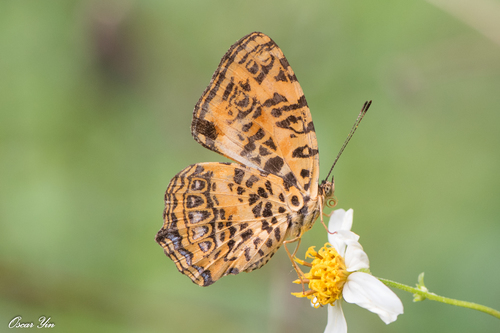
Like many tropical butterfly species, Symbrenthia brabira shows different wing patterning between its wet season and dry season forms. For wet-season males, the upperside of the wings is fulvous-black with reddish-yellow bands. The underside is almost uniformly bright ochreous-yellow with small tessellated markings. The submarginal region of the hindwings has conical spots that are sparsely speckled with metallic-green scales. The marginal crescent-shaped markings (called lunules) are continuous and also speckled with metallic green. Wet-season females have slightly paler, broader bands than wet-season males, except the discoidal band, which is somewhat narrower. Their subapical band touches the costa, with two very small apical spots above its end. All bands on the hindwing are narrower than they are in males. The underside of the wings is identical to that of wet-season males. Dry-season males have duller fulvous-black wings and paler bands than wet-season males. The bands on both wings are very broad with irregular edges. The underside is bright ochreous-yellow with narrower, less uniform tessellated markings. The submarginal spots on the hindwings are less conical, and their centers have very sparse metallic speckling. Dry-season females are similar to dry-season males, but have even paler, broader markings. Both male and female Symbrenthia brabira have a wingspan of 45 to 58 mm.