About Sylviorthorhynchus desmursii Des Murs, 1847
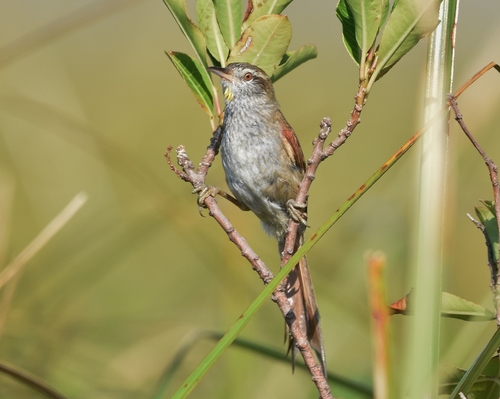
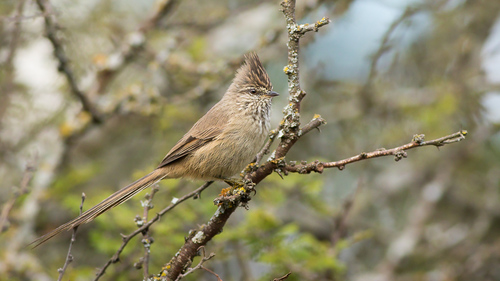
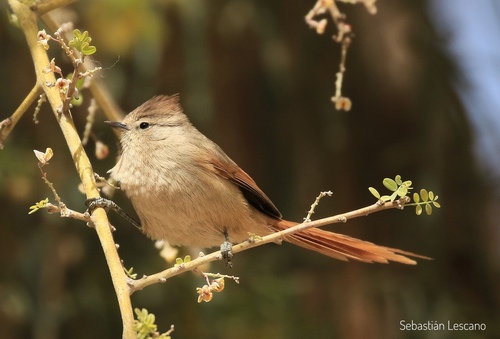
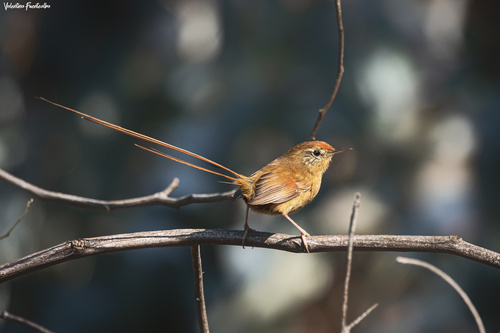
Des Murs's wiretail, Sylviorthorhynchus desmursii, measures 24 centimetres (9.4 in) in total length, with its extremely long tail making up roughly two-thirds of this length. It weighs only 10 grams (0.35 oz). Its tail has just six very narrow, filament-like feathers; only the Australian emu-wrens are known to have such a small number of rectrices among other birds. The two central tail feathers are greatly elongated, while the two outer tail feathers are very short. This species has plain plumage that is reddish-brown on the upperparts and paler on the underparts. It has a pale stripe above the eye. It has a small, rounded body and a very fine bill. Its song is fast and high-pitched.
This species is found in western Argentina, ranging from Santa Cruz Province north to San Juan. It is also found in southern and central Chile, from northern Magallanes to the Valparaíso Region. It lives in dense Chusquea bamboo thickets within cool temperate rainforests, at elevations from sea level up to 1,200 metres. It can also occur in early-successional shrublands dominated by highly shade-tolerant Myrtaceae species, mainly Amomyrtus. In the northernmost part of its range, Des Murs's wiretail is also found in dense weedy thickets of plants such as gorse. Even in undisturbed rainforests, wiretails only forage in the low-level shrub and bamboo layer, and never fly higher than 3 metres (10 ft) above the ground.
Des Murs's wiretail is very shy and difficult to observe. It cannot survive in areas that lack dense vegetative overstoreys, and typically cannot use corridors smaller than 25 m (80 ft) wide or fly further than 50 m (160 ft) between patches of suitable habitat. When encountered, it can easily be mistaken for a mouse. It has a unique ability among birds: it can curl its long tail into a ball when alarmed. It builds a ball-shaped nest from plant fibres, placed among vegetation close to the ground.
Both partners of a pair are highly territorial, with each pair holding a territory of around 1 hectare (2.5 acres). However, pairs holding territories smaller than 20 hectares (49 acres) are rarely successful at nesting. Pairs vigorously defend their territory and nest site against other members of the species using a distinctive territorial song. It has been hypothesized that the long tail is used by both sexes for mate choice, though no studies have yet tested how wiretails select mates. Following the pattern typical of south temperate insectivorous birds, Des Murs's wiretail lays a clutch of two to four eggs during its breeding season from October to February. Relative to the bird's body mass, these are among the largest eggs of any passerine bird. The eggs measure 20.5 mm (0.8 in) long and 15.8 mm (0.6 in) wide, and each egg weighs twice as much as expected for a 10 gram passerine. A full clutch of four eggs weighs more than the adult female, a trait only matched by the much more fecund kinglets. Due to the species' highly secretive behaviour, little is known about its incubation period, fledging period, or postfledging parental care.