About Syagrus romanzoffiana (Cham.) Glassman
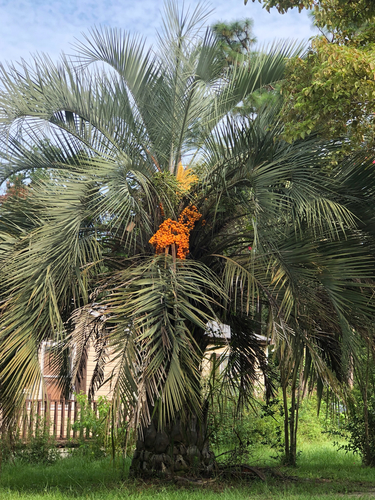
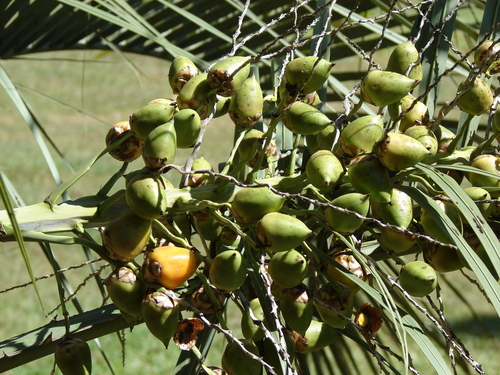
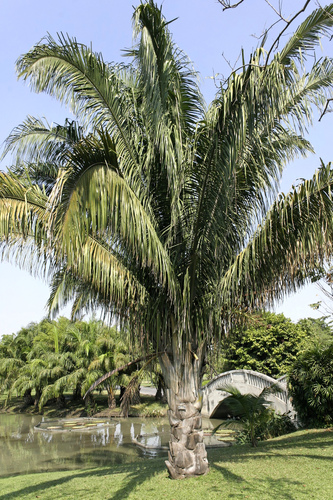
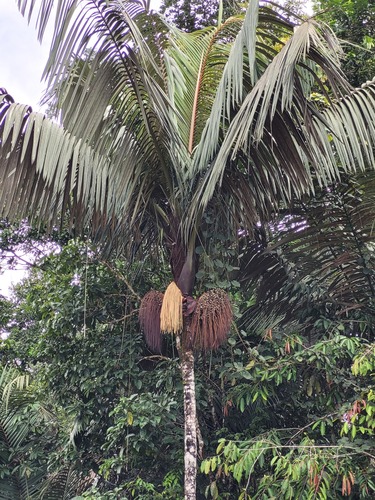
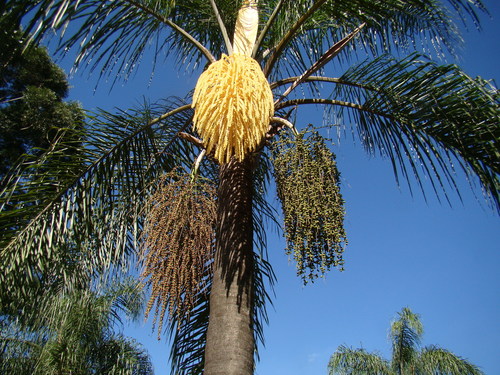
Syagrus romanzoffiana, commonly called queen palm, cocos palm, or Jerivá, is a palm species native to South America, planted globally as a popular ornamental garden tree. This is a medium-sized palm that matures quickly, reaching a maximum height of 15 m (49 ft). It has pinnate leaves that can hold up to 494 pinnae (leaflets), though 300 leaflets is more typical. Each individual pinna measures approximately 50 centimetres (18 in) long and 3–5 centimetres (1–2 in) wide. In its native range, this palm occurs from eastern and central Paraguay and northern Argentina, north to eastern and southern Brazil and northern Uruguay; it is also native to Bolivia, and is quite common across its native distribution. In Brazil, it grows in the states of Bahia, Distrito Federal, Goiás, Mato Grosso do Sul, Espírito Santo, Minas Gerais, Rio de Janeiro, São Paulo, Paraná, Rio Grande do Sul, and Santa Catarina. In Argentina, it is found in the provinces of Buenos Aires, Chaco, Corrientes, Entre Ríos, Formosa, Mendoza, Misiones (including El Dorado, Guaraní, and Iguazú), Santa Fe, San Juan, and San Luis. In Uruguay, it occurs in the departments of Maldonado, Montevideo, Rivera, Rocha, Salto, Tacuarembó, and Treinta y Tres. In Paraguay, it is found in the departments of Alto Paraná, Amambay, Caaguazú, Canindeyú, Central, Concepción, Cordillera, Guairá, Ñeembucú, Paraguarí, and San Pedro. Outside of its native range, the queen palm has become partially naturalized in Florida (US), Queensland (Australia), Honduras, and the island of Mauritius. On Mauritius, seedlings have been recorded in gardens of the now highly residential Montagne Ory area near Moka, from 1981–1984 through at least 1999. The government of Queensland, Australia considers this palm a potential invasive plant and discourages homeowners from planting it, but it is not prohibited, restricted, or listed as a declared weed. According to the 1989 *Flora of Southeastern Queensland*, it is naturalized in southern Queensland and the Atherton Tableland. It is not considered invasive or naturalized in New South Wales, Australia, though numerous sightings have been recorded around Sydney and the New South Wales coast, including within nature parks. At least one local council in New South Wales has classified it as a noxious weed since 2010; as of 2015, it is not prohibited or restricted across the whole state, but is classified as a serious threat that is not widely distributed, within one local region. It was possibly first identified as a potential environmental weed for this area in a 1998 book, and its sale is discouraged while existing palms are being removed. It is widely planted across much of Florida and other parts of the southern United States, but was not yet widely established in regional floras as of 2000. It can also be found growing in some parts of the Mediterranean basin. Syagrus romanzoffiana is a common tree across many different habitats. Many bird species eat the fruit pulp of its fallen fruits: these include the rufous-bellied thrush (*Turdus rufiventris*), the bananaquit (*Coereba flaveola*), the violaceous euphonia (*Euphonia violacea*), the Brazilian tanager (*Ramphocelus bresilius*), and the tropical parula (*Parula pitiayumi*). Azure jays (*Cyanocorax caeruleus*) feed on fruit pulp both directly from the infructescence and from fallen fruit on the ground, usually swallowing fruits whole or moving them away from the parent tree. Two toucan species, *Ramphastos vitellinus* and *R. dicolorus*, pluck ripe fruits directly from the infructescence and regurgitate the seeds. The chachalaca gamefowl *Ortalis guttata* (or a closely related species, depending on taxonomic interpretation), along with two related guan species *Penelope obscura* and *P. superciliaris*, also feed directly on infructescence fruits and spread seeds through their defecation, so they may be important seed dispersers for this palm. The squirrel subspecies *Guerlinguetus brasiliensis* ssp. *ingrami* is an important seed predator of this palm where the two species' ranges overlap. The squirrel breaks open the nut with its teeth at one of the three pores in the nut shell, and preferentially targets bug-infested nuts. A long-term study of this squirrel's feeding behavior in a secondary Araucaria forest found that while other plants are consumed in larger quantities during certain seasons, the palm nuts are eaten in large quantities throughout the entire year, making them the squirrel's most important food source. Other important seed predators are seed-boring weevils and palm bruchid beetles of the genus *Pachymerus*. Grubs of *P. bactris*, *P. cardo*, and *P. nucleorum* have all been found within the seeds of this palm, alongside many other related South American palm species. The large, colorful weevil *Revena rubiginosa* appears to be the main seed predator in numerous areas, and is thought to likely be a specialist seed predator of this palm. It infests developing seeds before fruits are ripe, while they are still attached to the infructescence; when the fruits fall, grubs exit the seed to pupate in the soil around the palm. Two other weevil species, *Anchylorhynchus aegrotus* and *A. variabilis*, are also seed predators of this palm, but these species are also flower visitors and likely important specialized pollinators. The palm's fruits are eaten by tapirs, which may be important seed dispersers, and by some wild canids such as the pampas fox and the crab-eating fox. Three studies conducted in Brazil across four locations that lack other large frugivores (including squirrels, peccaries, deer, and tapirs) found that ring-tailed coatis (*Nasua nasua*) are important seed dispersers for the palm in these areas. Coatis climb into the palm to access fruit; one urban study found palm fruit remains in 10% of all coati stool samples, although it only made up 2.5% of total faecal matter. Other important seed-dispersing mammals are azara's agoutis (*Dasyprocta azarae*), which sometimes cache seeds. Black-eared opossums (*Didelphis aurita*) and russet rice rats (*Euryoryzomys russatus*) have also been found among the palm's fallen fruits. The palm's leaves are consumed by caterpillars of multiple butterfly species: *Blepolenis batea* in Uruguay (1974 record), *Brassolis astyra* ssp. *astyra*, *B. sophorae*, and *Catoblepia amphirhoe* in Santa Catarina (1968 record), while *Opsiphanes invirae* (either the nominate form or possibly subspecies *remoliatus*) has been recorded feeding on this palm in both of these regions. *O. quiteria* was also recorded feeding on the palm's leaves in Argentina in 1969. Larvae of the giant day-flying moth *Paysandisia archon* are known to attack the piths of this palm species, along with many other palm species, at least in Europe where neither the moth nor the queen palm are native. This moth can kill the palm, though it prefers other palm genera with hairier trunks, such as *Trachycarpus*, *Trithrinax*, or *Chamaerops*. Caterpillars of the Indonesian butterfly *Cephrenes augiades* ssp. *augiades* and the Australian butterfly *C. trichopepla* may also feed on the leaves of this palm. The bases of pruned fronds remain attached to the tree for several months, and can serve as a habitat for insects or snails. Queen palm is planted in many tropical and subtropical regions globally. It is a popular ornamental tree widely used in urban landscaping, and is hardy down to -5 °C (USDA zone 9a). Dead fronds must be pruned to keep the tree visually attractive, and fallen fruit is known to attract unwanted insects in some areas. In Brazil, this palm is often cut down to use its leaves and inflorescences as cattle fodder, especially during droughts; its leaves are used for the same purpose in Argentina. The palm's fruits are edible and sometimes eaten: they consist of a hard nut surrounded by a thin layer of fibrous orange flesh that is sticky when ripe, with a sweet flavor described as a mixture of plum and banana. According to 1982 work by Blombery & Rodd, people eat the unexpanded leaves of apical buds in some regions. Fallen fruits are fed to pigs, and palm trunks are often used in construction, frequently hollowed out to make water pipes or aqueducts for irrigation. In 1920s Argentina, it was cultivated as a crop. Its young buds are eaten as vegetables, pickled, or preserved in oil, and the palm trunk provides sago.