About Swainsona procumbens (F.Muell.) F.Muell.
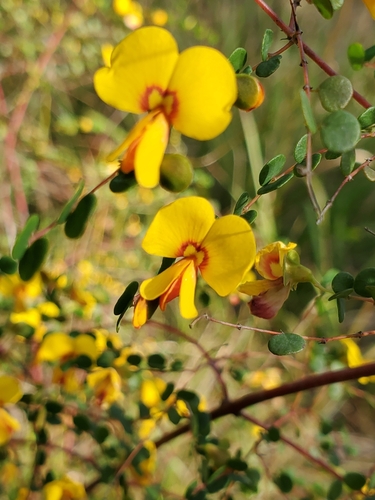
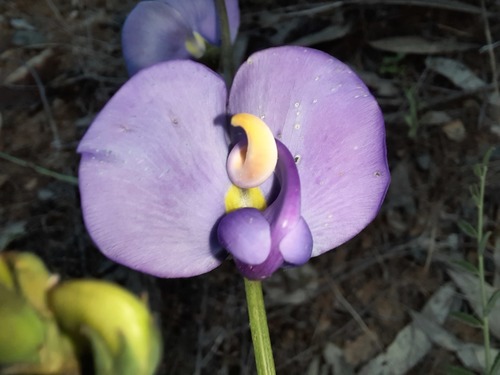
Swainsona procumbens, commonly known as Broughton pea, is a perennial herb with a spreading or ascending growth habit that resembles a shrub. It grows up to 50 cm (20 in) high and has mostly hairless, smooth stems. Its leaves are 50–150 mm (2.0–5.9 in) long, imparipinnate, and carry 15 to 25 leaflets. Each leaflet is 5–25 mm (0.20–0.98 in) long and 1–5 mm (0.039–0.197 in) wide, with a notch or blunt tip. Leaflet surfaces are hairless, though soft hairs sometimes develop on the lower surface. Stipules measuring 2–7 mm (0.079–0.276 in) long grow at the base of each leaf petiole. Flowers are arranged in racemes that hold 2 to 12 flowers each. Individual flowers are mostly 8–15 mm (0.31–0.59 in) long. Sepals are joined at the base, forming a tube 2.0–2.5 mm (0.079–0.098 in) long, with sepal lobes longer than the tube itself. The standard petal is 6–16 mm (0.24–0.63 in) long and 9–22 mm (0.35–0.87 in) wide, the flower wings measure about 9–15 mm (0.35–0.59 in) long, and the keel is about 8–12 mm (0.31–0.47 in) long and around 3 mm (0.12 in) deep. Flowering occurs from May to October. The fruit is an elliptic, curved pod 15–35 mm (0.59–1.38 in) long and 5–8 mm (0.20–0.31 in) wide, with the remains of the style remaining 10–20 mm (0.39–0.79 in) long. This species grows on heavy, frequently waterlogged soils or on sand dunes. It occurs on the western slopes and plains of inland New South Wales, in inland Victoria, and in Queensland.