About Swainsona lessertiifolia DC.
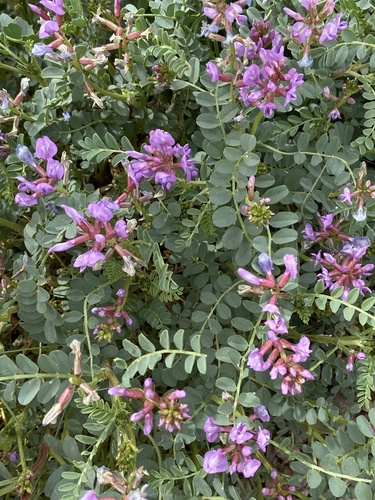
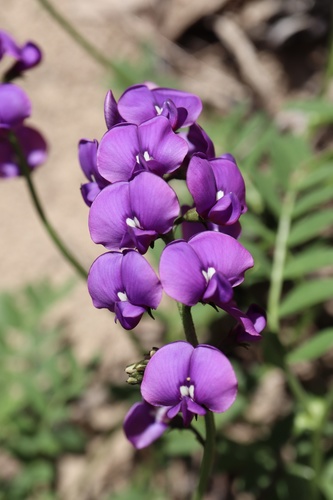
Swainsona lessertiifolia DC. is an erect or ascending perennial herb that usually grows up to 50 cm (20 in) tall. Its leaves are mostly 60–90 mm (2.4–3.5 in) long, and carry 13 to 21 narrowly elliptic to elliptic leaflets. The leaflets measure 4–25 mm (0.16–0.98 in) long and 2–10 mm (0.079–0.394 in) wide. Hairy stipules 2–7 mm (0.079–0.276 in) long grow at the base of each petiole. Flowers are arranged in racemes that are mostly 100–300 mm (3.9–11.8 in) long, holding 12 to 25 flowers on a peduncle 1–2 mm (0.039–0.079 in) wide. Each individual flower is 8–10 mm (0.31–0.39 in) long, growing from a hairy pedicel around 2–4 mm (0.079–0.157 in) long. Sepals are joined at the base to form a hairy black, bell-shaped tube 2.0–2.5 mm (0.079–0.098 in) long, and the sepal lobes are usually shorter than the tube. Petals range from dark to pale purple, and are rarely white. The standard petal is 10–11 mm (0.39–0.43 in) long and 8–16 mm (0.31–0.63 in) wide, the wings are 7–8 mm (0.28–0.31 in) long, and the keel is 8–10 mm (0.31–0.39 in) long and 4 mm (0.16 in) deep. Flowering occurs mostly from August to January. The fruit is elliptic, measuring 10–30 mm (0.39–1.18 in) long and 5–8 mm (0.20–0.31 in) wide. This species of Swainsona grows in South Australia, Victoria and Tasmania, most often on sand hummocks in near-coastal areas. In South Australia, it is found in the south-east of the state. In Victoria, it is abundant and occurs mostly west of Wilsons Promontory. In Tasmania, it grows at Woolnorth, St Marys, and on the Bass Strait Islands.