About Swainsona formosa (G.Don) Joy Thomps.
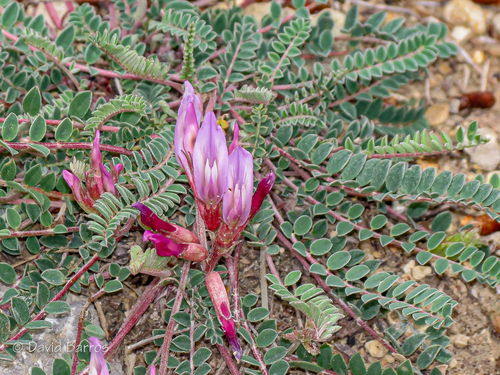
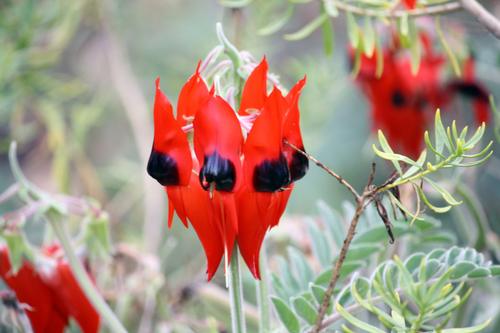
Swainsona formosa is a prostrate annual or short-lived perennial herb. It produces several densely softly-hairy stems, that are mostly 4–8 mm (0.16–0.31 in) wide. Its leaves are mostly 100–150 mm (3.9–5.9 in) long, and bear around 15 elliptic to egg-shaped leaflets. Leaflets measure 10–30 mm (0.39–1.18 in) long and 5–12 mm (0.20–0.47 in) wide, with the end leaflet slightly longer than the others. Broad, densely hairy stipules, sometimes 15 mm (0.59 in) or larger, grow at the base of the petiole. Flowers are arranged in racemes about 100–150 mm (3.9–5.9 in) long, each holding 2 to 6 flowers. The flowers are most often red, but can sometimes be white or other colours. The raceme grows from a peduncle 50–150 mm (2.0–5.9 in) long, and each individual flower sits on a shaggy-hairy pedicel 5–20 mm (0.20–0.79 in) long. The sepals are joined at the base, forming a bell-shaped tube 5–6 mm (0.20–0.24 in) long, with narrowly egg-shaped lobes that have thread-like tips. The lobes are twice as long as the tube. The standard petal is 40–60 mm (1.6–2.4 in) long and very narrow, with its base curving into a domed, usually black, shiny boss. The wings are 35–40 mm (1.4–1.6 in) long and taper to a narrow point, while the keel is 50–60 mm (2.0–2.4 in) long, 12–15 mm (0.47–0.59 in) deep, and ends in a narrow tip. Flowering occurs from June to October. The fruit is a hairy pod or follicle 40–90 mm (1.6–3.5 in) long and 10–12 mm (0.39–0.47 in) wide, round in cross-section. It has a stalk 5–15 mm (0.20–0.59 in) long, and retains the remains of a style around 30–40 mm (1.2–1.6 in) long. Most forms of this plant are low-growing or prostrate, but varieties growing up to 2 metres tall have been observed in the Pilbara region of north-western Australia. Commonly called Sturt's desert pea, this species is widespread across arid inland Australia, found in Western Australia, South Australia, the southern parts of the Northern Territory, western parts of New South Wales, and Queensland. It grows in red sandy or loamy soils, in mulga woodland, near creek lines, on stony hills, and sometimes in other woodlands and open plains. In the wild, its flowers are pollinated by birds. Sturt's desert pea, previously described as Clianthus formosus, was adopted as the floral emblem of the state of South Australia on 23 November 1961. Its iconic status in Australia, especially in South Australia, has made it a popular subject for artwork and photography. It appears in the logos of the Outback Communities Authority, the National Parks and Wildlife Service South Australia, and the associated volunteer umbrella organisation Friends of Parks. It has also made many appearances in prose and verse, and features in some Aboriginal legends. Sturt's desert pea has appeared on several releases of Australian postage stamps depicting Australian floral emblems, issued in 1968, 1971 and 2005. The flower also features on the logo of Charles Sturt University, which is named after the explorer Charles Sturt.