About Sutorius eximius (Peck) Halling, Nuhn & Osmundson
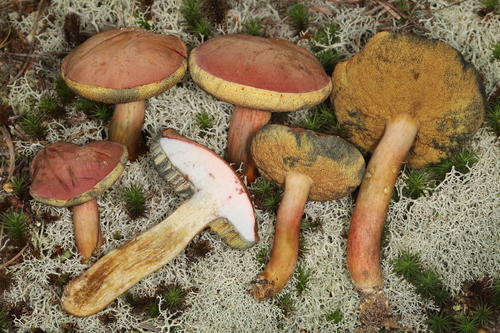
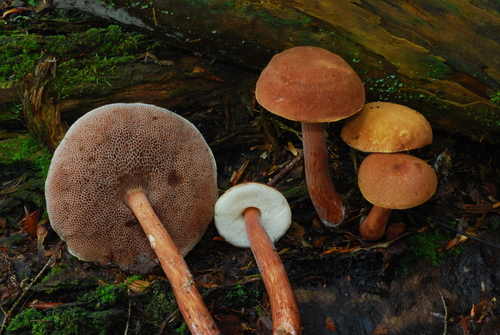
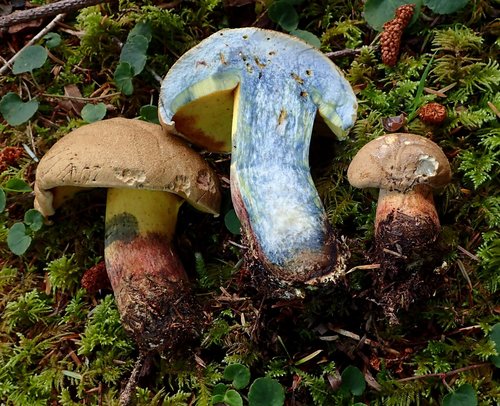
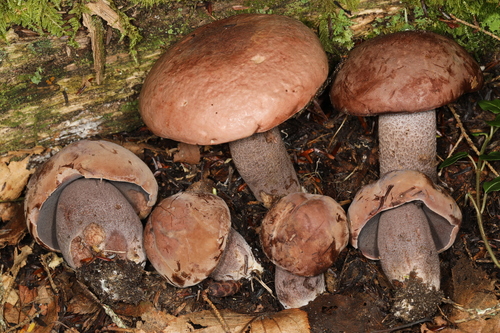
Sutorius eximius, commonly known as the lilac-brown bolete, produces fruit bodies with caps that start convex, and mature into broadly convex to nearly flat shapes, measuring 5–12 cm (2.0–4.7 in) in diameter. The cap surface is dry to slightly sticky, with a texture from smooth to somewhat felt-like, and colored purplish brown, grayish brown, or reddish brown. Young specimens are often covered in a fine, delicate powdery whitish bloom. The flesh is whitish, and slowly turns gray-brown when cut or injured. It has no distinct odor, and a mild to slightly bitter taste. On the underside of the cap, the pore surface is dark chocolate brown to purple brown, and stains dark brown when bruised. Pores are nearly circular, reaching up to 3 per millimeter, and the pore tubes are 0.9–2.2 cm (0.4–0.9 in) deep. The solid stipe is 4.5–9 cm (1.8–3.5 in) long and 1–4 cm (0.4–1.6 in) thick. It shares a similar color to the cap, and has a scurfy surface from a dense covering of purplish to purple-brown scabers. This species produces a pinkish to reddish-brown to amber-brown spore print. Its smooth, translucent spores are narrowly spindle-shaped, and measure 11–17 by 3.5–5 μm. Collections from Costa Rica have shorter spores (10.5–13.3 μm) and smaller fruit bodies than specimens from eastern North America; Guyanese collections also have smaller spores, measuring 9.7–12 μm. These size differences are considered clinal variation. The spore-bearing basidia are club-shaped, four-spored, and measure 23–30 by 7–8 μm. Cheilocystidia (cystidia on pore edges) are narrowly spindle-shaped (fusoid), measuring 20–30 by 7–8 μm. Pleurocystidia (cystidia on the pore surface) are thin-walled, fusoid to swollen (ventricose), with dimensions of 27–42 by 8–12 μm. There are no clamp connections in the hyphae of Sutorius eximius.
Sutorius eximius is a mycorrhizal species. Its fruit bodies grow on soil, either singly or scattered among leaf litter, and have been recorded growing in association with plants from multiple genera, including Dicymbe, Dipterocarpus, Fagus, Hopea, Quercus, Shorea, and Tsuga. Confirmed distributions include eastern North America (where it fruits from June to September), Costa Rica, and Indonesia. In Costa Rica, it typically associates with endemic oaks Quercus seemannii and Q. copeyensis, and can be locally abundant in the Cordillera Central and Cordillera de Talamanca. Unconfirmed collections (not verified by DNA analysis) have also been reported from Guyana, Japan, and China. While the species was previously reported from Thailand, molecular analysis of Thai collections shows these represent a separate, still unnamed species.