About Surnia ulula (Linnaeus, 1758)
Male northern hawk-owls (Surnia ulula) are generally 35–42.5 cm (13.8–16.7 in) long and weigh around 300 g (11 oz). Females are slightly larger, measuring 37.2–44.7 cm (14.6–17.6 in) in length and weighing approximately 340 g (12 oz). Both sexes have similar wingspans, ranging from 69–82 cm (27–32 in).
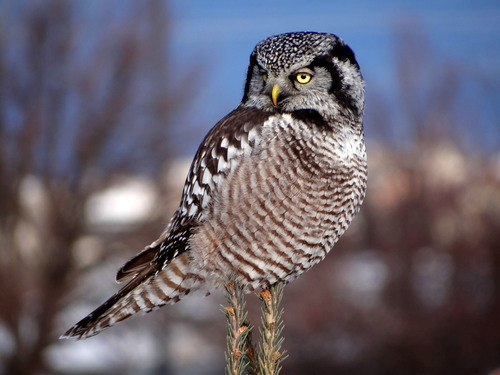
The plumage of this owl is predominantly dark brown, with an off-white spotting pattern on all dorsal (upper) parts of the body. The only exception is the back of the neck, which has a distinct black V-shaped pattern. The underbelly is generally white or off-white, extending all the way to the toes, with brown bands across the breast and stomach. Northern hawk-owls have a long tail with brown banding; adult owls have rounded tail feather tips, while first-year birds have pointed tail tips. They have a white face outlined with a black border, a rounded head, yellow eyes, and a curved yellow beak.
Three recognized subspecies differ in size and plumage tone. S. u. ulula has paler underparts with fine barring, while S. u. caparoch is browner on the underparts with heavier barring. S. u. tianschanica is slightly the largest of the three, darker on the upper body than the other two subspecies, and has intermediate barring on its underparts.
The northern hawk-owl resembles hawks in both appearance and behavior. In North America, it is often considered similar in flight to the Cooper's hawk (Astur cooperii). It has been suggested that this similarity may exist because the northern hawk-owl partially fills a diurnal (daytime) niche similar to that of day-hunting hawks.
The three subspecies are distributed across the northern Holarctic. The North American subspecies S. u. caparoch ranges from eastern Alaska through Canada to Newfoundland, and in some areas extends south into the northern United States. The other two subspecies occur in northeastern Europe and Siberia: S. u. tianschanica breeds in Central Asia, reaching as far as Xinjiang, China, while S. u. ulula lives across Siberia to its easternmost range.
Occasionally, S. u. caparoch extends its range as far south as northern Minnesota and many other northern U.S. states, including more central states such as West Virginia, New York, and South Dakota. These southern movements into the northern United States are rare, and generally occur during winter, or after a population boom of their prey. S. u. ulula can also occasionally be found further south in areas such as Great Britain, southern Russia, and Scandinavia after prey population booms.
Northern hawk-owls have an uneven, highly variable distribution across the boreal forest. They mostly live in open coniferous forests, or mixed coniferous-deciduous forests that include tree species such as larch, birch, poplar, and willow. They can be found in muskegs, clearings, swamp valleys, meadows, or recently burnt areas, and generally avoid dense spruce-fir forests. Their winter habitat is usually the same as their breeding habitat.
The northern hawk-owl feeds on a wide variety of prey, ranging from small rodents to larger mammals, as well as many different bird species, which is a typical diet for most boreal owls. In Eurasia, the northern hawk-owl feeds primarily on voles of the Microtus family. These voles typically have a 3–4 year population cycle, so S. u. ulula numbers decrease when vole populations are at their lowest. In North America, the subspecies S. u. caparoch also feeds on microtine voles, but its overall population size is primarily tied to the 10-year population cycle of the snowshoe hare (Lepus americanus). In Eurasia, microtine voles make up around 94% of the northern hawk-owl's consumed biomass, while in North America, voles can contribute as little as 20% of the total biomass the owls consume. Juvenile snowshoe hares are far more important, contributing 40–50% of consumed biomass. Other important prey for the northern hawk-owl includes the red squirrel (Sciurus vulgaris), which has been documented to make up as much as 20% of the hawk-owl's consumed biomass. A wide range of other prey are also taken, including mice, rats, voles, lemmings, cottontails, shrews, moles, the short-tail weasel (Mustela erminea), partridge, spruce grouse (Canachites canadensis), doves, pileated woodpeckers (Dryocopus pileatus), sparrows, jays, robins, starlings, buntings, grackles, and finches. Frogs and even fish are sometimes taken. In winter, the owls' feeding patterns change: while mammals are the main food source in summer, a larger portion of the winter prey biomass comes from ground-dwelling birds such as ptarmigan and grouse.
The northern hawk-owl is a partially diurnal hunter, though it has been recorded hunting at many different times and does not appear to have a preferred hunting time. Hunting strategy is generally similar regardless of whether the owl lives in Eurasia or North America. Northern hawk-owls perch and scan the surrounding area for prey. As a search-oriented species, they typically do not stay at one perch for long if no prey is found there. They prefer open forest environments for perching, including sphagnum bogs and partially deforested areas, and the spruce tree is their preferred perching tree. When attacking, the owl moves from a horizontal posture into a gliding dive. If prey is further away, the owl will flap its wings a few times during the dive to extend its range. Northern hawk-owls have exceptional hearing, and can plunge into snow to capture rodents hiding below the surface. The owl's feeding strategy depends on the type of prey caught. For mammalian prey, the process follows a general routine: the northern hawk-owl eviscerates its prey, eats the head first (especially for prey such as red squirrel, which have relatively large heads), then for larger prey, it eats the organs and caches the remaining carcass; smaller prey is simply swallowed whole.