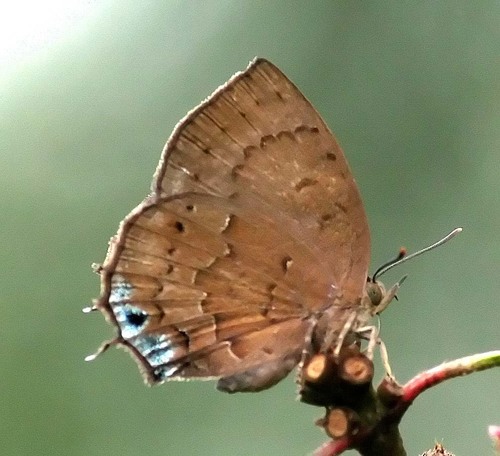
About Surendra vivarna (Hewitson, 1862)
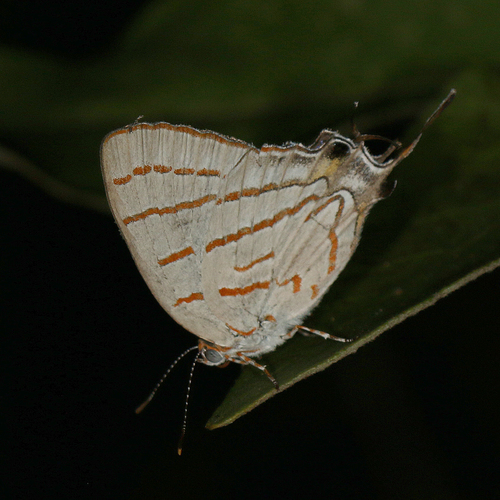
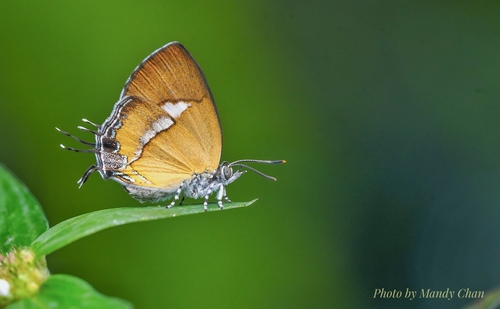
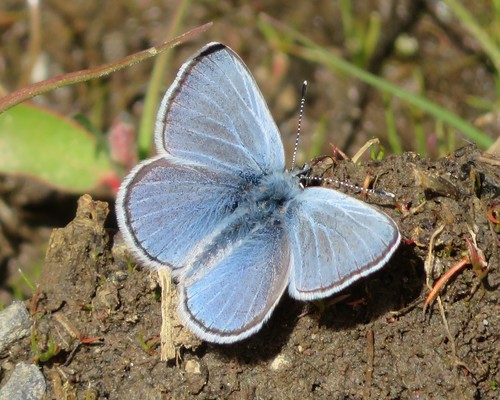
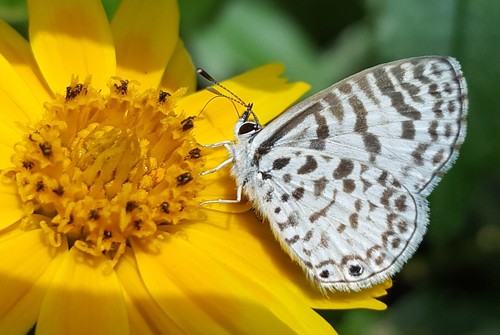
Surendra vivarna, originally described by Hewitson in 1862, has the following appearance. For males: the upperside of both wings is a rather intense deep blue. On the primary wings, the costa is broadly black, the posterior margin is more broadly black, and the apex is even more broadly black. On the secondary wings, the blue is restricted to just over the median area, with the rest of the wing being black. Males have two black tails, and the longer of the two has a white tip. On the underside of both wings of males, the color is a very dark greyish brown. The primary wings have an obscure dark dot near the center of the cell and a small dash that closes the cell; the costa has three dark dots. An irregularly curved, scalloped transverse blackish line runs from the costa to the submedian nervure. There is a submarginal row of blackish dots, the margin is obscurely dark, and the internal area is quite pale. The secondary wings have a small white spot about one-third of the way along the costal nervure, with an obscure dark short dash in the cell below this spot. From two-thirds of the way along the costa to the middle of the abdominal margin runs a narrow, indefinite, obscure band of dark shading, which is sharply edged with white on its outer side. There is a submarginal row of dark spots that forms an almost lunular line. Slight grey scaling is present on each side of the long tail. For females: the upperside of both wings is entirely dark brown. The underside matches that of the male, but is decidedly paler. The range of Surendra vivarna is similar to that of other species in the genus Surendra, with the exception that it has not been recorded from China or the main Philippines (where it is replaced by S. maniliana); it has been recorded from Balabac, Palawan, and the Calamian Islands. Its known food plants belong to the family Fabaceae, specifically Acacia, Albizia, and Paraserianthes. This species is facultatively attended by various ants.