About Suksdorfia violacea A.Gray
Suksdorfia violacea A.Gray is an uncommon species of herbaceous flowering plant in the saxifrage family, commonly called violet suksdorfia. In 1879, Asa Gray named the genus Suksdorfia after Wilhelm Nikolaus Suksdorf. Suksdorf had first collected a specimen of this species in 1878 near the Mount Adams–White Salmon area of Washington, and sent it to Gray to help classify it. Gray and Suksdorf shared a long, close working relationship, and Gray initially identified and named many species that Suksdorf discovered. NatureServe has rated this species’ global conservation status as "G4 – Apparently Secure".
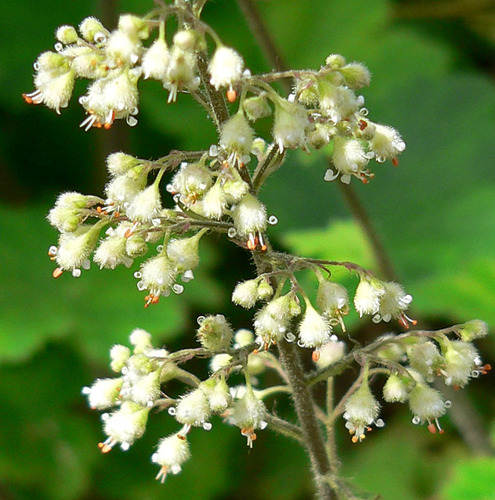
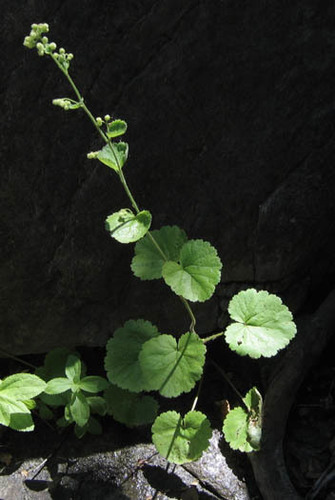
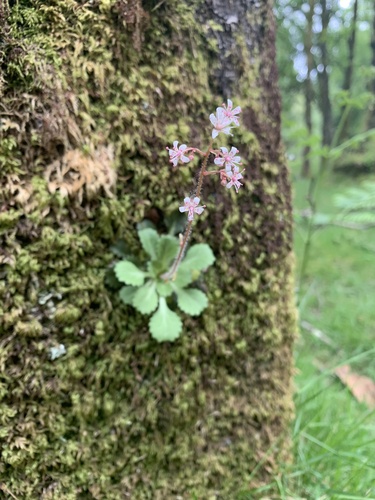
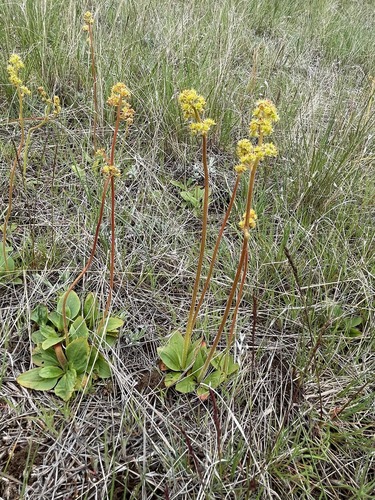
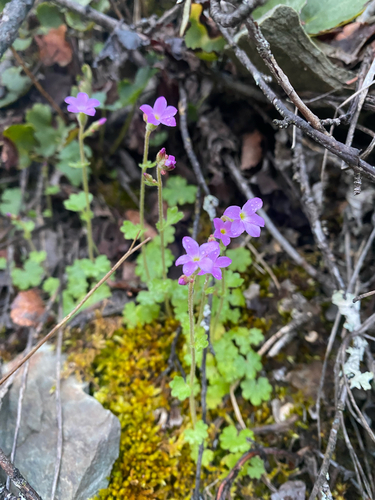
This plant is distributed across Washington, British Columbia, Oregon, Alberta, Montana, and Idaho. It is most abundant in Washington and southeast British Columbia. It favors moist habitats, including rocky sites, rock crevices, cliff ledges, and fence lines. It is a perennial plant that grows from rhizomes. It bears rounded leaves on petioles, which are 1 to 2.5 centimeters (0.39 to 0.98 inches) wide. Its calyx is shaped like a slender bell. The flower is five-lobed, violet-colored, slender and tapered, and has 5 stamens. Fruits of this species are 4 to 6 millimeters (0.16 to 0.24 inches) long, and contain brown seeds that measure 0.5 millimeters (0.020 inches) across. Mature plants typically reach 10 to 20 centimeters (3.9 to 7.9 inches) in height, growing in small groups at lower elevations.