About Suillus viscidus (L.) Roussel
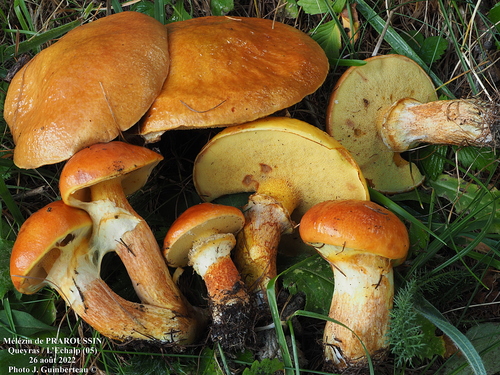
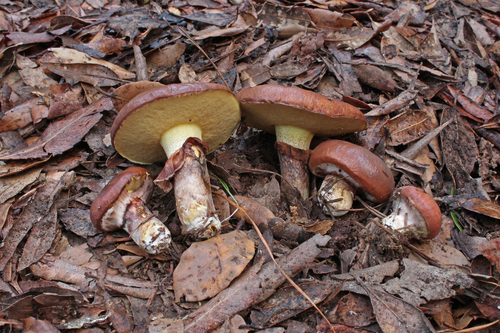
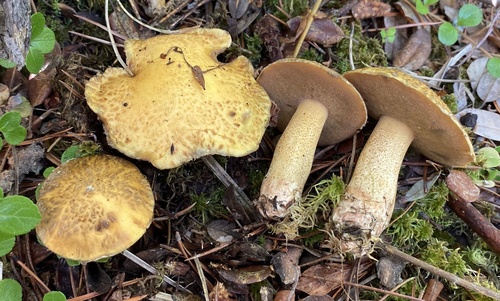
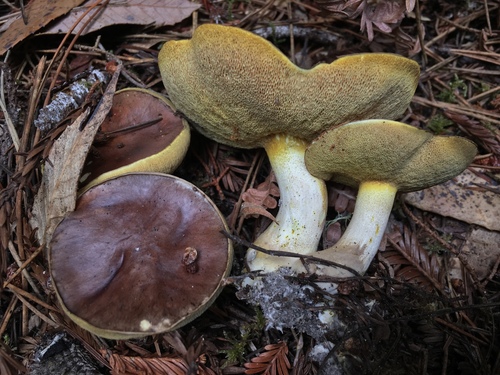
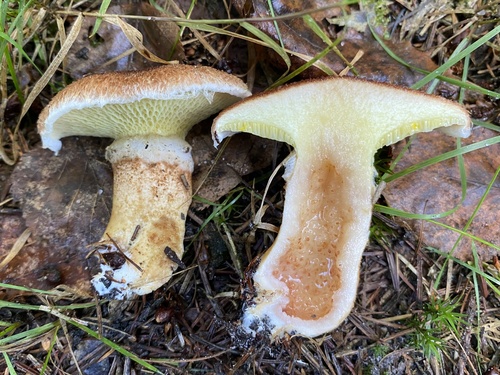
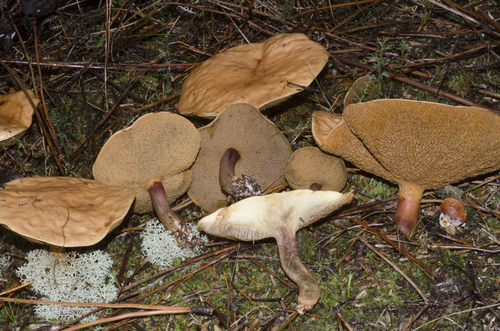
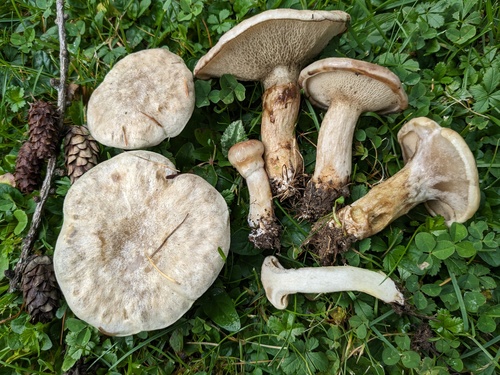
The cap of Suillus viscidus is hemispherical when young, and becomes convex to flat as it matures. Its color ranges from whitish grey to darker shades, and it can reach up to 12 cm in diameter. The cap surface is slimy, and becomes blotchy when the mushroom is old. On the underside of the cap, large angular pores are pallid to yellowish when young, and darken as the mushroom matures. Young specimens have a whitish partial veil that shreds quickly, sometimes leaving fragments attached to the edge of the cap. The tubes match the pore color, and attach to the stem in a slightly decurrent arrangement. A thin, slimy, dark-colored ring forms on the uppermost section of the stem; this ring is sometimes lost from mature specimens. The ring divides the stem into two sections: a short, lighter yellowish section above the ring, and a duller greyish, viscid section below the ring. The flesh is whitish, very soft, stains bluish when cut or bruised, and has a mild or indistinct taste. The spores are clay-colored, ellipsoid or subfusiform in shape, and measure 10–12 by 4–5.5 μm. This is an edible mushroom of low quality. Suillus viscidus forms ectomycorrhizal associations specifically with larch (Larix), so its distribution is limited to the range of its host tree. It occurs across Europe and also in Japan. In Europe, it is classified as an uncommon to rare fungus, and grows in the same habitat as the common larch bolete Suillus grevillei and the rare Suillus tridentinus. Fruiting bodies grow in groups in grass under larch trees, from summer to autumn.