About Suillus salmonicolor (Frost) Halling
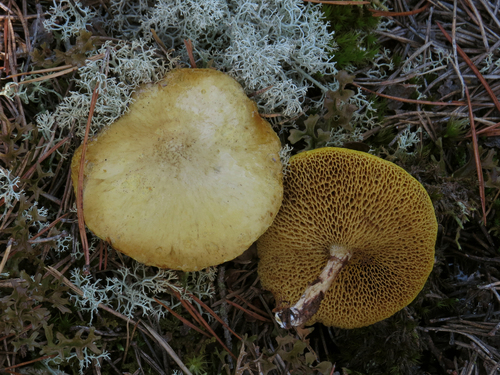
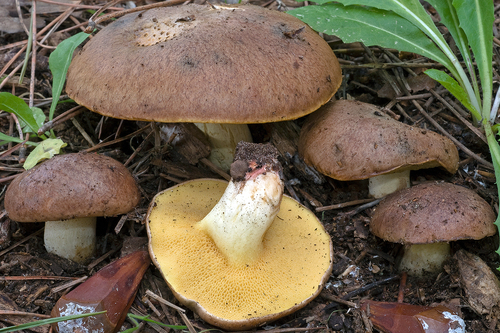
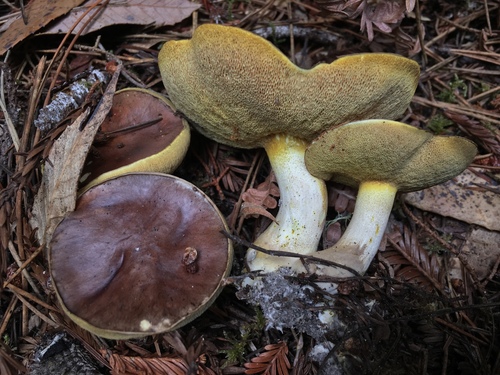
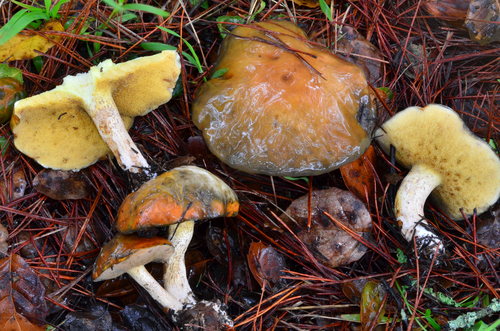
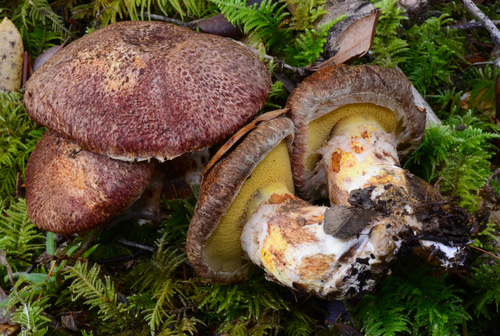
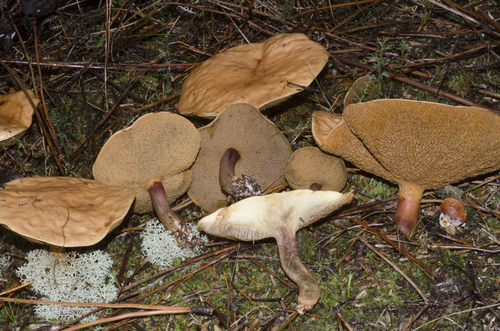
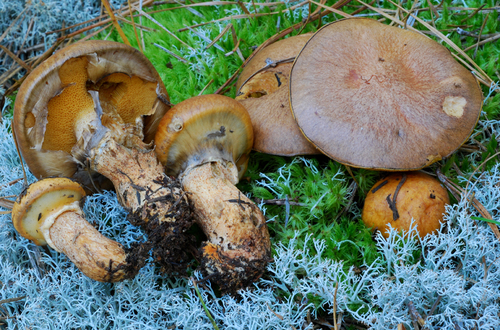
Suillus salmonicolor (Frost) Halling has a cap that is bluntly rounded, convex, or nearly flattened, growing to 3–8 cm (1–3 in) in diameter. When moist, the cap surface is sticky to slimy, and it becomes shiny when dry. Cap color is variable, ranging from dingy yellow, yellowish-orange, and ochraceous-salmon, to cinnamon-brown, olive-brown, or yellow-brown. The cap flesh is pale orange-yellow, orange-buff, or orange, and does not change color when exposed to air. Its odor and taste are not distinctive. The pore surface on the underside of the cap is yellow, dingy yellow, yellowish orange, or salmon, and darkens to brownish as it ages; it also does not stain when bruised. The pores are circular to angular, 8–10 mm (5⁄16–3⁄8 in) deep, with 1–2 pores per mm. The stem measures 2.5–10 cm (1–4 in) long, 6–16 mm (1⁄4–5⁄8 in) thick, and is either equal in width along its length or slightly wider in the lower portion. The stem is whitish, yellowish, or pinkish-ochre, with reddish-brown to dark brown glandular dots and smears on its surface. These glandular dots are made of clumps of pigmented cells, and can be rubbed off with handling — unlike the reticulation or scabers (small visible fiber tufts found on the stems of other Suillus species). The stem flesh is ochraceous to yellowish, and often salmon-orange at the stem base. The partial veil, which protects the developing pores, is initially thick, baggy, and rubbery. It often has a conspicuously thickened cottony roll of tissue at its base, and sometimes flares outward from the stem on its lower portion. The partial veil forms a gelatinous ring on the upper to middle part of the stem. The spore print of Suillus salmonicolor is cinnamon-brown to brown. When a drop of dilute potassium hydroxide (KOH) or ammonia solution, chemical reagents commonly used for mushroom identification, is applied to the cap surface, it first turns a fleeting pink color, then dark red as the flesh collapses. Spores are smooth, roughly ellipsoid in shape, inequilateral when viewed in profile, and measure 7.6–10 by 3–3.4 μm. In dilute KOH solution, spores appear hyaline (translucent) to yellowish; when stained with Melzer's reagent, they appear cinnamon to pale ochraceous. Basidia are somewhat collapsed, hyaline, and 5–6 μm thick. Cystidia are scattered, sometimes arranged in clusters especially on the pore edge, and usually have an ochraceous-brown content, though they are occasionally hyaline. They are club-shaped to somewhat cylindrical, and measure 34–60 by 10–13 μm. The cap cuticle is an ixotrichodermium: a cellular arrangement where the outermost hyphae are gelatinous, grow roughly parallel like hairs, and extend perpendicular to the cap surface. These hyphae are hyaline, narrowly cylindrical, and measure 1.4–3 μm in diameter. The stem surface is made of scattered bundles of caulocystidia — cystidia on the stem — which are brown or sometimes hyaline in KOH. These are club-shaped to subcylindrical bundles interspersed among hyaline cells. Under these bundles lies a layer of gelatinous, hyaline, vertically oriented, parallel, narrow cylindrical hyphae. Clamp connections are absent from the hyphae. Suillus salmonicolor forms mycorrhizal associations with various Pinus pine species, a mutualistic relationship: the fungus's subterranean mycelia forms a protective sheath around the tree's rootlets, plus a hyphal network called the Hartig net that penetrates between the tree's epidermal and cortical cells. This association helps the plant absorb water and mineral nutrients, and in exchange the fungus receives carbohydrates made by the plant via photosynthesis. S. salmonicolor has been recorded associating with two-, three-, and five-needled pines. In North America, where the fungus fruits from August to October, it has been found growing with P. banksiana, P. palustris, P. resinosa, P. rigida, P. strobus and P. taeda. It has been found with P. pumila in Kamchatka, Russian Far East, with P. kesiya in the Philippines, and with P. patula in southern India. In North America, its northern range limit is Quebec, eastern Canada, and its southern limit is Nuevo León and near Nabogame in Temósachi Municipality, Chihuahua, Mexico. It has also been collected from the Dominican Republic in the Caribbean, Japan, Taiwan, and Mpumalanga, South Africa. Since South Africa has no native Pinus species, the fungus is assumed to be an exotic species introduced via pine plantations. It has also been introduced to Australia, where it is known from a single collection made in a Caribbean pine (Pinus caribaea) plantation in Queensland, and has been found growing with Caribbean pine in Belize. In Hawaii, it occurs under Slash Pine (Pinus elliotii), including in lawns where these trees are used for landscaping. S. salmonicolor is one of several ectomycorrhizal species that have traveled thousands of kilometers from mainland to Hawaii in the roots and soil of introduced seedlings.