About Suillus luteus (L.) Roussel
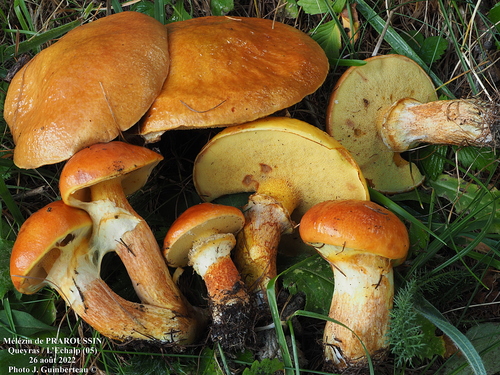
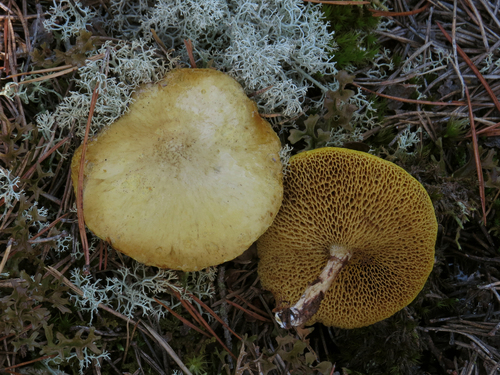
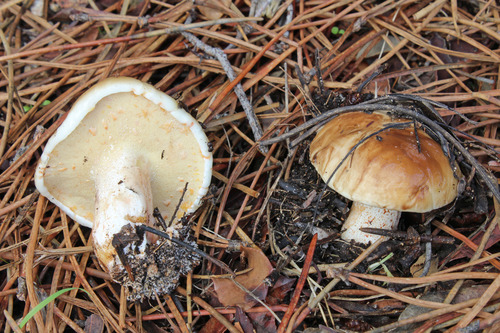
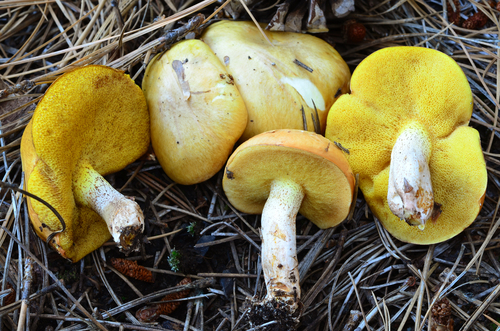
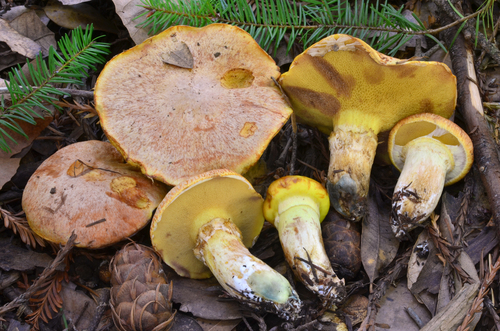
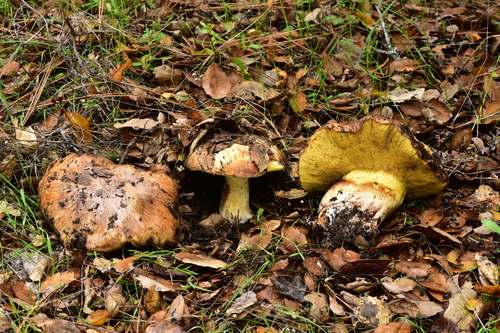
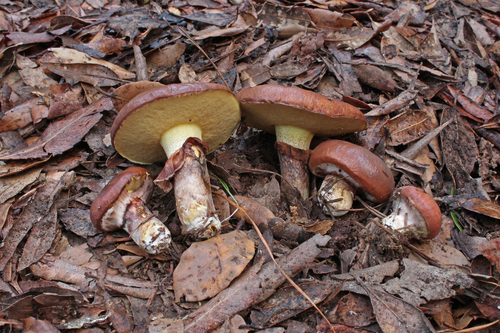
Suillus luteus, formally Suillus luteus (L.) Roussel, has a cap that ranges in color from chestnut, rusty, olive brown to dark brown, with a diameter of 4–10 centimetres (1+1⁄2–4 in), and rarely reaches up to 20 cm. Young caps have a distinctive conical shape that flattens out as the fungus matures. The cap surface is slimy to the touch, bare, smooth, and glossy even when dry, and its cuticle can be easily peeled off. The tiny, circular pores on the cap’s tubes are initially yellow, and turn olive to dark yellow as they mature. Like the cap skin, these pores can be readily peeled away from the fungus flesh. The tubes that make up the hymenophore on the underside of the cap are 3–7 mm (1⁄8–1⁄4 in) deep, and their attachment to the stipe ranges from adnate to somewhat decurrent. The pores are very small: young specimens have 3 pores per mm, while mature specimens have 1–2 pores per mm. The stipe grows 5–10 cm (2–4 in) tall and 2–3 cm (3⁄4–1+1⁄4 in) wide. It is pale yellow, more or less cylindrical, and may have a swollen base. A membranous partial veil initially connects the stipe to the edge of the cap. When the veil ruptures, it forms a hanging membranous ring; the top side of the ring is whitish, while the underside is characteristically dark brown to violet. This species is one of the few members of the genus Suillus that has this type of ring. Above the ring, the stipe has glandular dots, which are minute clumps of pigmented cells. Below the ring, the stipe is dingy white, and sometimes streaked with brownish slime. In humid conditions, the ring has a gelatinous texture. The white flesh of the entire fungus does not change color when damaged, and it is soft, particularly in mature specimens. It has a pleasant taste and has no distinctive odor. The spore print is ochre or clay colored, and the elongated elliptical spores measure 7–10 by 3–3.5 μm. The spore-producing basidia are four-spored, with dimensions of 14–18 by 4–5 μm. Cystidia are present on both the tube faces (pleurocystidia) and tube edges (cheilocystidia), occurring either scattered or more rarely in bundles. They measure 20–35 by 5–7 μm and have a narrow club shape. Clamp connections are not present in the hyphae of S. luteus. Suillus luteus is found throughout the Northern Hemisphere. It is native to Eurasia, and is widespread across the British Isles. To the east, it has been recorded in Pakistan, where it was found along canals in Dashkin, Astore District, and occurs as far east as South Korea. It has also been widely introduced to other regions worldwide through pine plantations. It is very commonly found in Monterey pine (Pinus radiata) plantations, even though this tree is native to California, outside the fungus’ native range. In North America, it occurs in the northeastern, northwestern, and southwestern United States. According to Ernst Both, Charles Horton Peck first suggested in 1887 that the fungus was introduced to New York state on Pinus sylvestris. DNA studies show that North American populations have very little genetic difference from European populations, which supports the idea that the fungus arrived in North America relatively recently due to human activity. Suillus luteus grows in coastal and mountainous pine forests and tolerates northern latitudes. In the Southern Hemisphere, this species (commonly called slippery jack) grows with plantation pines in South America, Africa, Australia, and New Zealand. In southwestern Australia, the bolete is only found in areas with more than 1000 mm (40 in) of annual rainfall. It has been recorded as far north as the Darling Downs and southern Queensland, and occasionally in Tasmania. The fungus produces fruit bodies in spring, summer, and quite prolifically in autumn, after periods of wet weather. Mushrooms can grow in large troops or fairy rings. In Ecuador, Pinus radiata plantations were planted extensively around Cotopaxi National Park, and Suillus luteus boletes grow in abundance year-round. A 1985 field study estimated production of 3000–6000 mushrooms per hectare, up to 1,000 kilograms (2,200 lb) of dry weight mushrooms per hectare per year. This continuous production differs from the species’ seasonal fruiting elsewhere. The fungus is not found in adjacent areas of native vegetation. Fruiting is so abundant that harvesting slippery jacks has become the main reason pine plantations are established or maintained in parts of Ecuador. In southern Brazil, it has been recorded in slash pine (P. elliottii) plantations in the municipalities of Pelotas, Nova Petrópolis and Canela in Rio Grande do Sul, and Colombo in Paraná. It is particularly common in plantations in Patagonia. Suillus luteus is the most common bolete found in the Falkland Islands, where it occurs in windbreaks and gardens. In South Africa, Suillus luteus has been occasionally recorded growing under pines in Bloemfontein, Johannesburg and Royal Natal National Park. Suillus luteus is a pioneer species that typically establishes itself during the early stages of forest succession. The fungus forms mycorrhizal associations with various pine species, including Scots pine (P. sylvestris), black pine (P. nigra), and Macedonian pine (P. peuce) in Europe, and red pine (P. resinosa) and white pine (P. strobus) in North America. An in vitro experiment showed that the species can form an ectomycorrhizal association with Aleppo pine (P. halepensis), a key species used for reforestation in the Mediterranean. A study of ectomycorrhizal fungi associated with an invasive lodgepole pine (P. contorta) front near Coyhaique, Chile, found that many invasive trees were supported by S. luteus as their sole mycorrhizal partner. The ectomycorrhizae formed between the fungus and host plant can be affected by soil microorganisms in the mycorrhizosphere. For example, soil bacteria from the genera Paenibacillus and Burkholderia alter the branching structure of host roots, while Bacillus species increase root growth and mycorrhizal colonization. The fungus does not require a specific soil type, but appears to prefer acidic and nutrient-deficient soil. Suillus luteus produces hydroxamic acid-based siderophores, compounds that can chelate iron and extract it from soil in nutrient-poor conditions. Ignacio Chapela and colleagues analyzed carbon uptake of S. luteus in Ecuador, and concluded that pine plantations associated with S. luteus deplete carbon stored in soil, raising concerns that these plantations may not be a solution for rising atmospheric carbon dioxide levels. The fungus has been shown to provide protective effects against heavy metal toxicity when associated with host Pinus sylvestris: it prevents copper accumulation in pine needles, and protects pine seedlings against cadmium toxicity. Due to its frequent sexual reproduction and the resulting extensive gene flow within populations, the fungus can rapidly evolve tolerance to otherwise toxic levels of heavy metals in the environment. The genetic basis of this adaptation, which is of great interest to researchers studying the bioremediation potential of metal-adapted plants and their fungal associates, is contained in the genome sequence of S. luteus, published in 2015. Suillus luteus fruit bodies are sometimes infested with larvae, though far less often than fruit bodies of S. granulatus or B. edulis. Maggot damage is much more common in warmer months, and rare late in the season when the weather is cooler. In a Finnish study, researchers found that 70–95% of fruit bodies collected from typical forest habitats were infested with larvae; the most common infesting species were the flies Mycetophila fungorum, Pegomya deprimata, and Pegohylemyia silvatica. In contrast, other studies have found that fruit bodies collected from pine plantations are relatively free of larvae. The fungus produces microscopic crystals of oxalic acid on the surface of its hyphae, a trait thought to help deter grazing by the springtail species Folsomia candida.