About Suillus lakei (Murrill) A.H.Sm. & Thiers
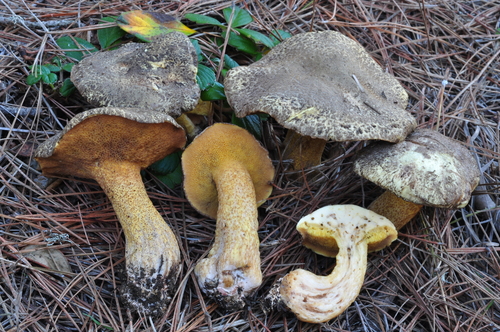
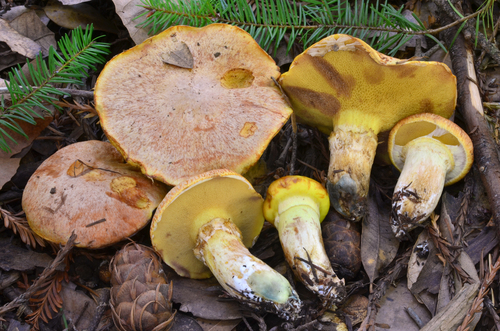
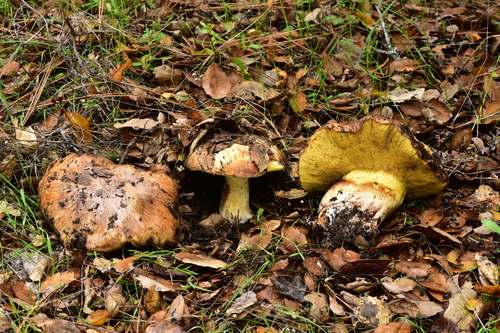
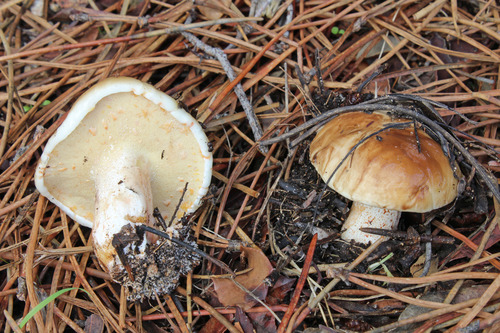
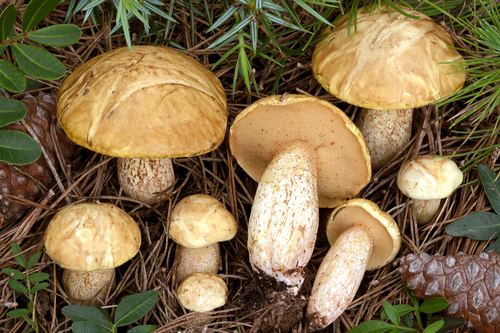
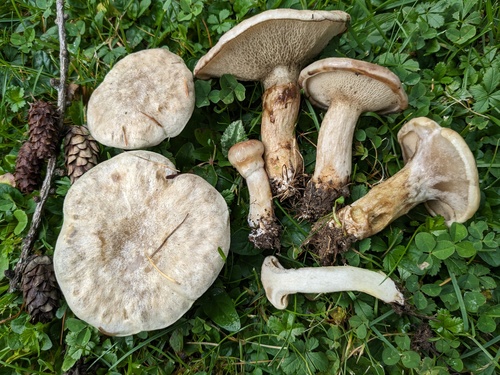
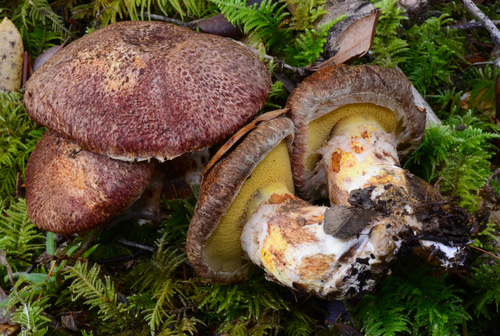
Suillus lakei (Murrill) A.H.Sm. & Thiers has a cap that reaches up to 15 cm (6 in) in diameter. It is initially convex, becoming somewhat flattened as it matures. The cap is fleshy and dry, with a color ranging from yellowish to reddish-brown that fades with age. The center of the cap is covered with flattened hairs or tiny tufted scales, with yellowish flesh visible between these scales. Heavy rain can wash away the cap’s surface fibrils, leaving behind a sticky, glutinous layer. Older specimens often become nearly smooth, and partial veil remnants may sometimes hang from the cap edge. The cap margin is initially curved or rolled inward, unfurling as the mushroom grows and may curl upward in maturity. The pore surface on the underside of the cap is made of tubes 5–12 mm (1⁄4–1⁄2 in) deep; the angular pores, up to 2.5 mm wide, are arranged radially. Pore color ranges from yellow to brownish-yellow to ochre, and turns brownish or reddish-brown when bruised. Young specimens have their pores covered by a partial veil. The flesh is thick and yellow, and either retains its color when bruised or broken, or turns pinkish-red. The stem measures 6 to 12 cm (2+3⁄8 to 4+3⁄4 in) long and usually 1–3 cm (3⁄8–1+1⁄8 in) thick. It is yellow, sometimes with reddish streaks, particularly below the ring zone, and is solid and yellow on the inside. Unlike some other Suillus species, S. lakei usually lacks the characteristic glandular dots on the stem. The stem is either equal in width along its length, or tapers downward. Cut tissue at the stem base may develop a faint bluish-green stain, though this reaction is usually not visible in mature specimens. The ring is delicate and floccose (similar to woolly tufts), and quickly disappears or leaves a thin whitish ring on the stem. The spore print color ranges from cinnamon to brown. One variety, S. lakei var. calabrus found in Italy, has a light yellow cap with purple-red scales. S. lakei var. pseudopictus has a cap that is redder and more scaly than the more common form. Spores are spindle-shaped to elliptical, smooth, and measure 8–11 by 3–4 μm. Basidia (spore-bearing cells) are both two- and four-spored, club-shaped, hyaline (translucent), and measure 28–36 by 10–12 μm. Cystidia are abundant; they occur in bundles lining the tube mouths as cheilocystidia, or more commonly singly along the tube sides as pleurocystidia. These structures are thin-walled, cylindrical, and measure 48–60 by 7–9 μm. The scales on the cap surface consist of more or less erect hyphae with clustered tips. Clamp connections are rare in the hyphae. Suillus lakei is native to the Rocky Mountains and western North America, with its range extending south into Mexico. Fruit bodies grow singly or in groups on the ground in young conifer stands or grassy parkland. Fruiting occurs in late summer and autumn, and is later on the West Coast. The species forms ectomycorrhizae with Douglas-fir (Pseudotsuga menziesii), and its distribution matches the range of this tree. It is one of the most common bolete species found in northwestern Montana and Idaho. In a laboratory pure culture study of host specificity, S. lakei failed to form healthy ectomycorrhizas with Eucalyptus roots; the hyphae were covered in mucilage-like deposits and appeared collapsed. The fungus is also noted to prefer poor, exposed soil such as that found on road banks and campgrounds. It can often be found growing alongside Gomphidius subroseus, another mushroom species that associates with Douglas-fir. Both Douglas-fir and S. lakei are non-native introduced species in Europe. The fungus has been found in several central and south European countries after the intentional introduction of Douglas-fir, including Bosnia and Herzegovina, Bulgaria, Czech Republic, Germany, Hungary, Italy, and Slovakia. It is classified as endangered in the Czech Republic. Suillus lakei has also been reported in South America (Argentina and Chile) and on the South Island of New Zealand.