About Suillus cothurnatus Singer
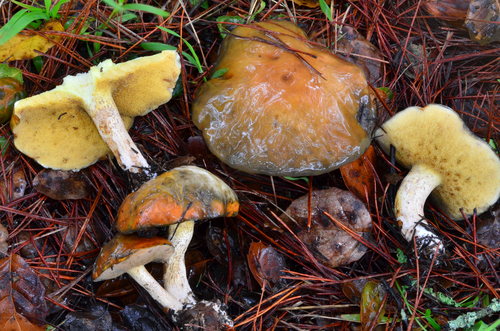
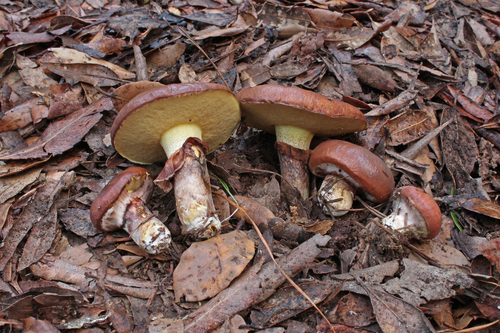
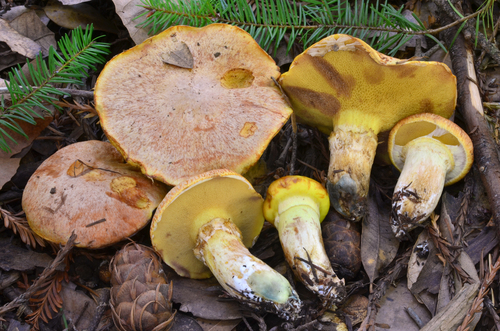
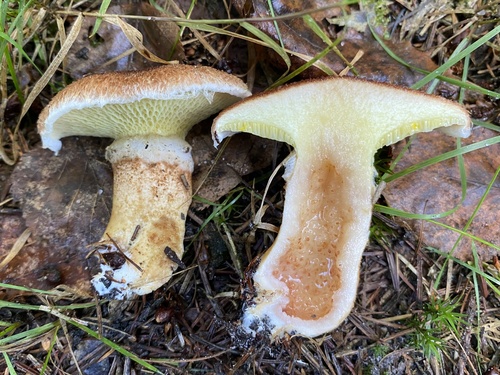
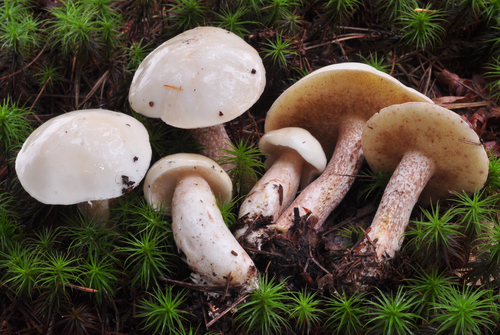
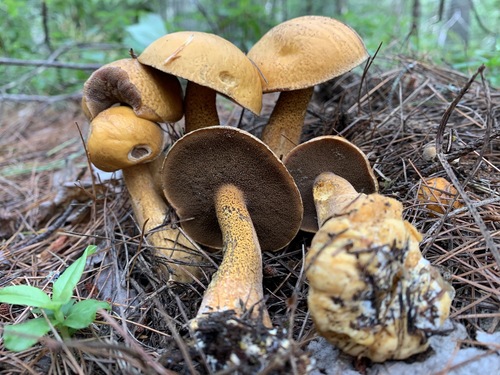
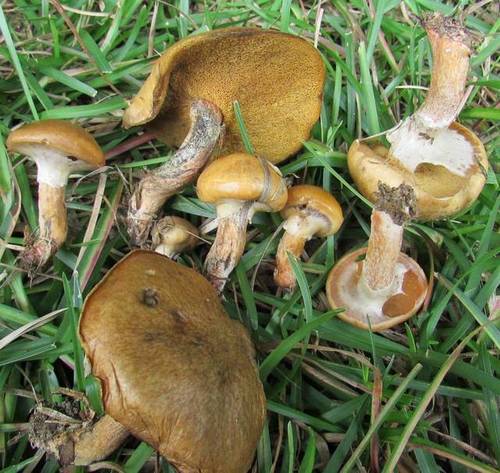
Suillus cothurnatus Singer has a cap that is obtuse to convex, and sometimes develops a broad umbo. The cap margin is initially turned inward, and usually has remnants of the partial veil hanging from it. The cap surface is smooth, sticky, and variable in color, ranging from yellow to yellow-brown, yellow-orange, cinnamon, olive brown, grayish brown, or dark brown. The flesh is marbled orangish and pale yellow, and stains dark purple-drab when cut or injured. The odor of Suillus cothurnatus ranges from fragrant to indistinct, and the taste is indistinct. The pore surface on the underside of the cap is initially pale yellow to orange-yellow, and becomes brownish yellow when mature. The pores measure 1 or 2 per millimeter, and are irregular to radially elongated. The tubes that make up the pore layer are roughly 4 mm (0.16 in) deep. The stem measures 2.5–6 cm (1.0–2.4 in) long by 0.5–1.0 cm (0.2–0.4 in) thick, and is nearly equal in width along its length, or slightly larger near the base. The stem is solid, with a dry surface covered in scattered brownish glandular dots, over a whitish to yellowish to brownish background color. It has a thick, baggy, whitish partial veil with a somewhat rubbery texture. The outer layer of the partial veil is slimy, and it forms a band-like ring on the stem with a flaring lower edge. The mycelium at the base of the stem is salmon-colored. This species produces a brown spore print. Its spores are roughly elliptical to oblong to somewhat cylindrical, smooth, and measure 8–10 by 2.5–3.5 μm. Fruit bodies of Suillus cothurnatus are edible. They are used in mushroom dyeing to produce colors including beige, light brown, or brownish orange, depending on the mordant used. Fruit bodies grow scattered or in groups on the ground in sandy soil near pine, especially two-needled pine such as red pine and jack pine. In the United States, its range extends from Texas to Florida, and north to North Carolina. The species is also found in Mexico, and has been introduced to Brazil. It has also been recorded from the Cameron Highlands in Malaysia.