About Suillus collinitus (Fr.) Kuntze
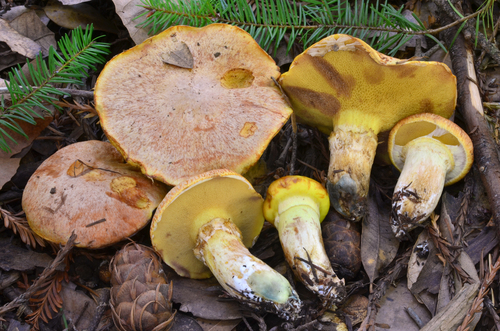
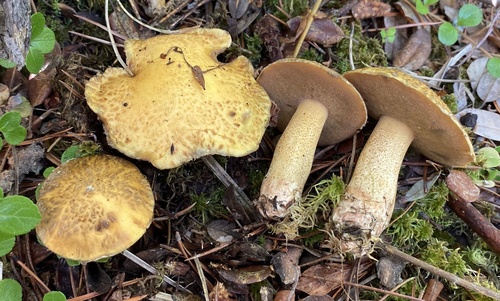
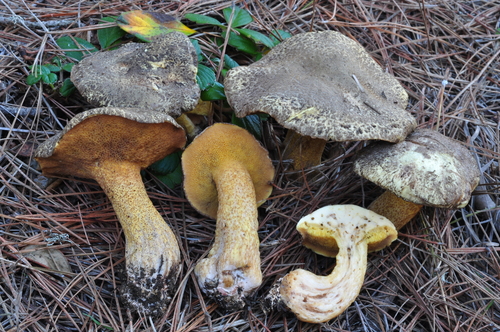
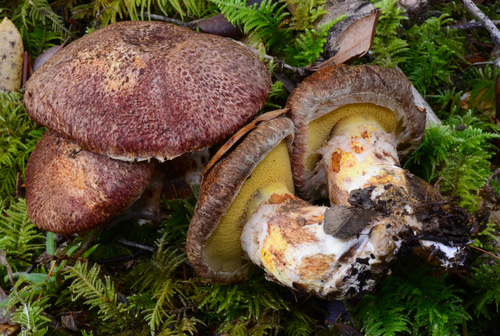
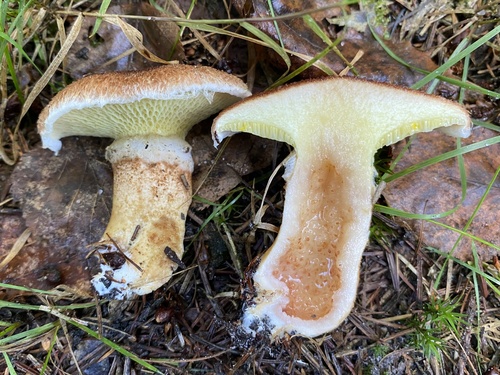
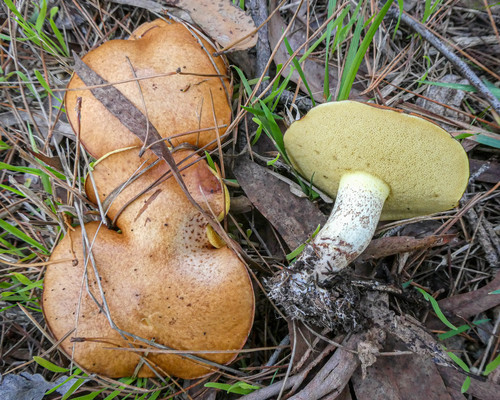
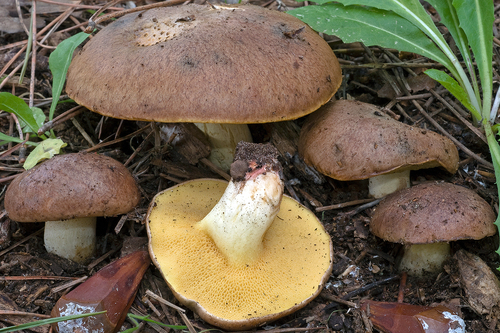
The fruit body of Suillus collinitus is a medium to large, fleshy bolete. Its cap starts rounded, becomes convex, and finally flattens, reaching up to 11 cm (4.3 in) in diameter. The cap is covered by a brown cuticle of varying shade, marked with tiny radial striations that are more obvious on fully expanded specimens, especially in dry weather. The cap is often irregularly shaped and becomes sticky when damp. The tubes are short, and their attachment to the stem is usually slightly decurrent to adnate. The small, angular pores are yellow and darken as they age. Young, fresh specimens sometimes produce clear fluid droplets that collect on the pore surface. The cylindrical stem is often short and stubby, typically 4–7 cm (1.6–2.8 in) tall and 1–2 cm (0.4–0.8 in) thick. It is yellowish in color and marked with sparse reddish-brown granules, and has no ring. The stem base has pink tones, and connects to distinctively pink mycelial threads that are visible when the fruit body is uprooted. The flesh is yellowish, thick, and soft. When tested with ammonia solution, the flesh turns reddish. Spores are ochre-brown in mass, and pale yellow when viewed under a light microscope. They are fusiform (tapered at both ends), and measure 8–10.5 by 3–4.5 μm. The spore-bearing basidia of the hymenium are four-spored. The cap striations and pink mycelium are especially characteristic features of S. collinitus. This fungus resembles S. granulatus, a common species found in European pine forests, in many aspects. Unlike S. collinitus, S. granulatus has a uniform brown cap with no striations, and its mycelium is characteristically white. Suillus collinitus is found across Europe. It is an ectomycorrhizal fungus that forms mutually beneficial symbiotic relationships with several pine (Pinus) species, including multiple two-needled European pines: Aleppo pine (P. halepensis), European black pine (P. nigra), stone pine (P. pinea), and Scots pine (P. sylvestris). The fungus prefers limestone soils. It is thermophilic, and is common in southern Europe. It is rarely found in more northern regions such as the British Isles and Poland. It is listed as near-threatened on the red list of Denmark, and as endangered on the red list of Estonia. It has also been collected in Iran, and was reported from the municipality of Paipa, Boyacá department, Colombia by mycologist Juan Camilo Rodríguez Martínez. Suillus collinitus is the most common fungus that associates with Aleppo pine, a hardy tree used for reforestation projects and soil conservation to prevent erosion in the Mediterranean region. A study in southern France found that S. collinitus and S. mediterraneensis are multi-stage ectomycorrhizal fungi that associate with both young and mature Aleppo pine stands. These two species may play a key role in the survival and adaptation of Aleppo pine on disturbed calcareous sites. Mycorrhizal roots with S. collinitus were found to be able to survive repeated disturbances from fire or ploughing. Additionally, the fungus retains the ability to propagate through its mycelial network, which supports recolonization by newly introduced trees. The fungus has also been shown to improve the growth of Mediterranean pines grown in greenhouses and nurseries. Unlike other Suillus species that grow in wet climates, such as S. grevillei and S. spraguei, S. collinitus does not usually produce fruit bodies in young plantations. This fruiting pattern may be caused by the typically nutrient-poor, dry Mediterranean environment combined with a lack of tree canopy. The absence of above-ground signs of the fungus makes it difficult to study underground populations, so molecular markers have been developed to help monitor fungal growth, as well as the formation and persistence of ectomycorrhizae in young plantations. The ectomycorrhizae formed between multiple Suillus species and Aleppo pine has been studied under in vitro laboratory conditions. Tree shoots inoculated with S. collinitus, S. bellinii, and S. mediterraneensis tended to grow better and showed better mycorrhizal development than other tested Suillus species, which suggests the three species have "physiological specificity" for Aleppo pine. A 2010 publication reported that the fungal hyphae of S. collinitus are covered in oxalic acid crystals. In addition to lowering soil pH, these crystals reduce grazing by the soil microarthropod Folsomia candida.