About Suillus brevipes (Peck) Kuntze
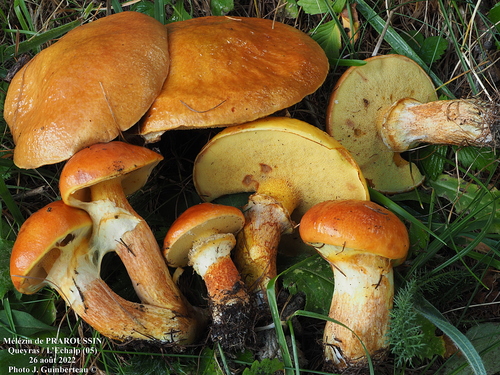
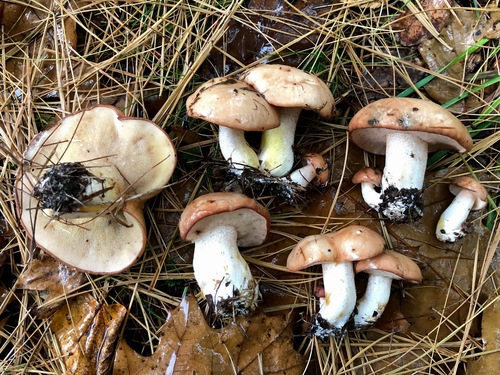
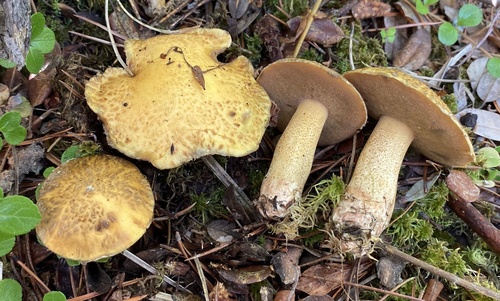
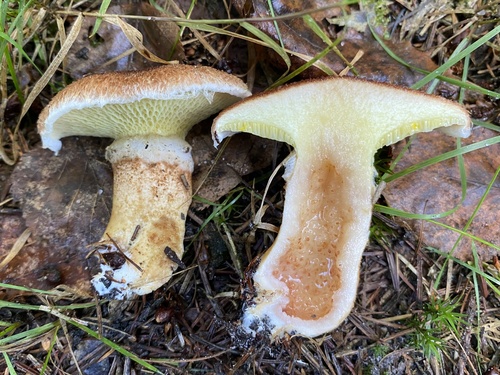
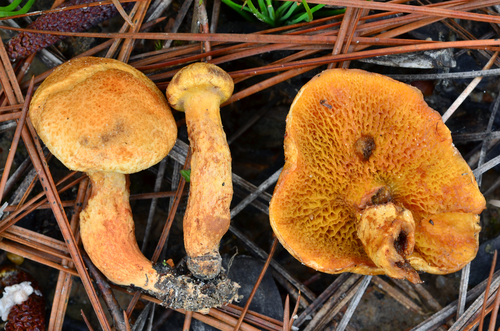
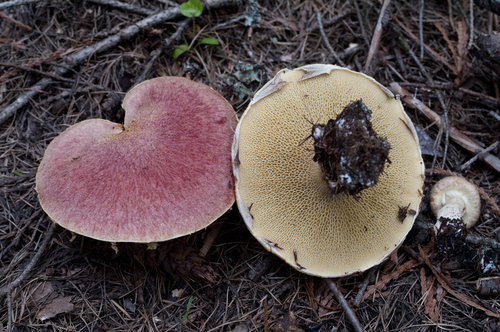
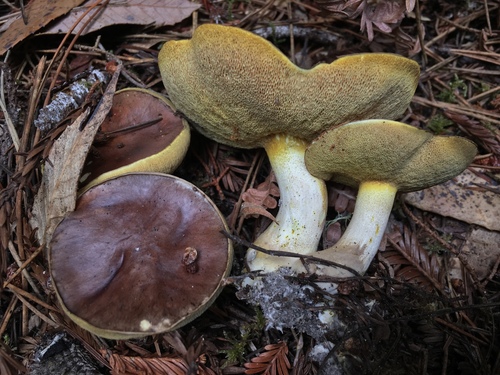
Suillus brevipes (Peck) Kuntze has a cap that ranges in color from deep brown to reddish-brown, fading to tan or yellowish as it ages, and does not bruise when handled. The cap surface is smooth, and its texture ranges from sticky to slimy depending on environmental moisture. Cap shape changes with maturity, shifting from spherical to broadly convex. The cap measures 5–10 cm (2–3 7⁄8 in) in diameter, and its cuticle can be peeled from the surface. The tubes are yellow when young, becoming olive-green with age, and their attachment to the stipe ranges from adnate (most of the tube fused to the stipe) to decurrent (tubes run partway down the stipe length). Tubes are typically up to 1 cm (3⁄8 in) deep, with 1–2 pore openings per millimeter. Pores are pale yellow, round, 1–2 mm wide, and do not change color when bruised. The stipe is white to pale yellow, dry, solid, does not bruise, and is pruinose, meaning it has a very fine whitish powder on its surface. Glandular dots, a common characteristic of many Suillus species, are clumps of hyphal cell ends that secrete metabolic waste to leave sticky or resinous dots. In S. brevipes, glandular dots are variable: they may be absent, slightly underdeveloped, or obscurely formed as the mushroom ages. The stipe is usually short relative to the cap diameter, typically 2–6 cm (3⁄4–2 3⁄8 in) long and 1–2 cm (3⁄8–3⁄4 in) thick. It is either equal in width along its length, or tapers downwards; at maturity, its surface has minute puncture holes, and it is slightly fibrous at the base. Collections from New Zealand often have reddish coloration at the very base of the stipe. The mushroom flesh is initially white, turning pale yellow with age. Both odor and taste are mild, and the spore print is cinnamon-brown. Microscopically, the spores are elliptical to oblong, smooth, and measure 7–10 by 3–4 μm. The spore-bearing basidia are thin-walled, club-shaped to roughly cylindrical, and measure 2–25 by 5–7 μm, with each bearing either two or four spores. Pleurocystidia (cystidia on the tube face) are roughly cylindrical with rounded ends, thin-walled, and measure 40–55 by 5–8 μm. These cells often have brown contents; they appear hyaline (translucent) or vinaceous (red wine-colored) in 2% potassium hydroxide (KOH), and turn pale yellow or brown in Melzer's reagent. Cheilocystidia (cystidia on the tube edge) measure 30–60 by 7–10 μm, are club-shaped to almost cylindrical, thin-walled, with brown incrusting material at the base, and are arranged in a fiber-like bundle. They appear hyaline in KOH, and turn pale yellow in Melzer's reagent. Caulocystidia (cystidia on the stipe) measure 60–90 by 7–9 μm, are mostly cylindrical with rounded ends, arranged in bundles with brown pigment particles at the base, and stain vinaceous in KOH. The cap cuticle is formed from a layer of interwoven gelatinous hyphae that are individually 2–5 μm thick; these gelatinous hyphae are what give the cap cuticle its slimy texture. There are no clamp connections in the hyphae. Suillus brevipes grows singly, scattered, or in groups on the ground in late summer and autumn. It is a common, sometimes abundant mushroom, found across most of North America from Canada to Mexico, including Hawaii. The species has also been introduced to other regions: it was found in Puerto Rico growing under planted Pinus caribaea, thought to have been introduced accidentally from North Carolina by the USDA Forest Service in 1955. Additional introductions have been recorded in exotic pine plantations in Argentina, India, New Zealand, Japan, and Taiwan. Suillus brevipes is a mycorrhizal fungus that forms a close symbiotic association with the roots of various tree species, especially pine. Its underground mycelia form a sheath around tree rootlets, and fungal hyphae penetrate between the root's cortical cells to form ectomycorrhizae. In this relationship, the fungus supplies minerals to the tree, and the tree supplies carbohydrates produced via photosynthesis to the fungus. In nature, it associates with two- and three-needle pines, most commonly lodgepole and ponderosa pine. In controlled laboratory conditions, it has been shown to form ectomycorrhizae with ponderosa, lodgepole, loblolly, eastern white, patula, pond, radiata, and red pines. In vitro mycorrhizal associations with non-pine species include Pacific madrone, bearberry, western larch, Sitka spruce, and coast Douglas-fir. Growth of the fungus is inhibited by high levels of the heavy metals cadmium (350 ppm), lead (200 ppm), and nickel (20 ppm). When pine forests regrow after disturbance such as clearcutting or wildfire, mycorrhizal fungi follow an orderly successional sequence with one species replacing another. A study of ectomycorrhizal succession in Canadian jack pine forests after wildfire found that S. brevipes is a multi-stage fungus. It appears relatively early in tree development; fruit bodies were common in 6-year-old tree stands, and the fungus colonized the highest proportion of root tips. It persists throughout the entire lifespan of the tree, having been found in tree stands aged 41, 65, and 122 years. However, its relative prevalence decreases as stands age, which may be caused by increased competition from other fungi and habitat changes from forest canopy closure. In general, S. brevipes responds well to silvicultural practices such as thinning and clearcutting. A 1996 study showed that fruit body abundance increases as disturbance severity increases. It has been proposed that the thick-walled, wiry rhizomorphs produced by the fungus are an adaptation that helps it survive and remain viable for some time after disturbance. The mushrooms are a common part of the diet of grizzly bears in Yellowstone National Park. Like many species in the genus Suillus, S. brevipes is edible, and some consider it a choice edible mushroom. It has a mild odor, and a mild or slightly acidic taste. Field guides typically recommend removing the slimy cap cuticle before eating, and also removing the tube layer from older specimens. The fatty acid composition of S. brevipes fruit bodies has been analyzed. Caps have a higher lipid content than stipes: 18.4% of dry weight in caps, compared to 12.4% in stipes. In caps, linoleic acid makes up 50.7% of total lipids (compared to 65.7% in stipes), oleic acid makes up 29.9% (12.4% in stipes), followed by palmitic acid at 10.5% (12.6% in stipes). Linoleic acid is an omega-6 essential fatty acid that is a required dietary nutrient for humans.