About Suillus bovinus (L.) Roussel
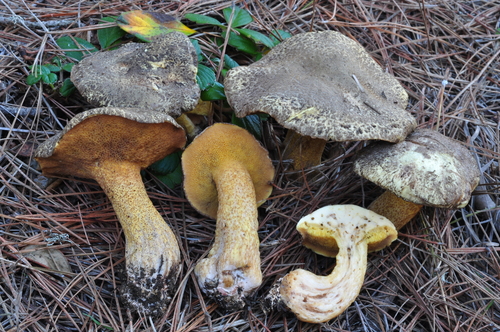
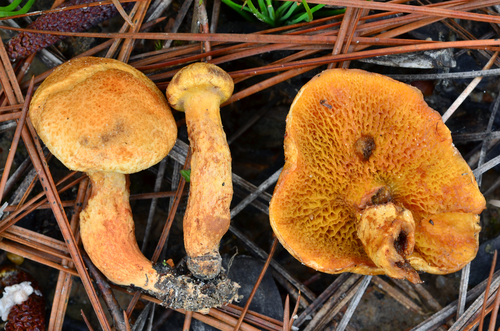
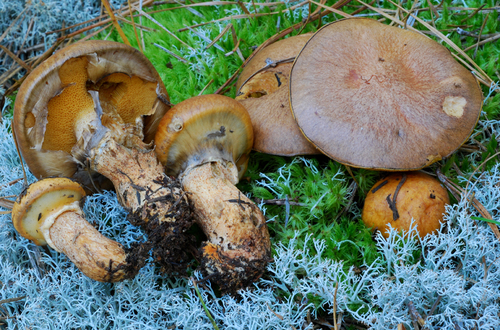
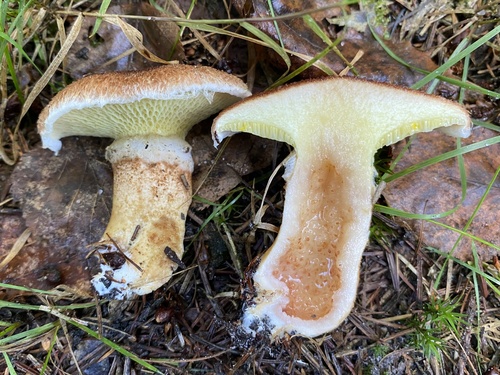
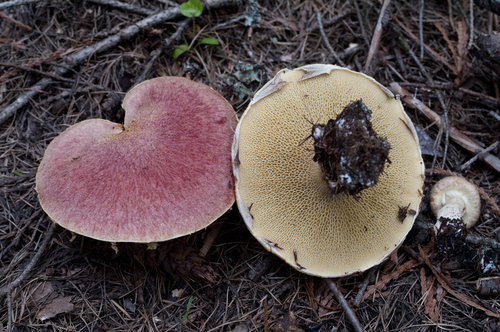
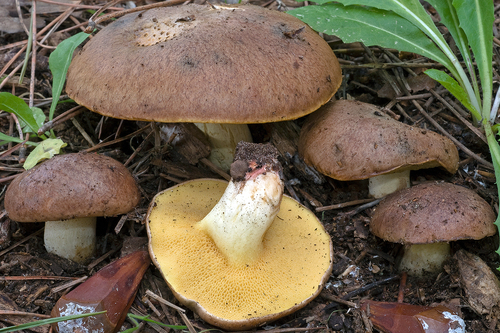
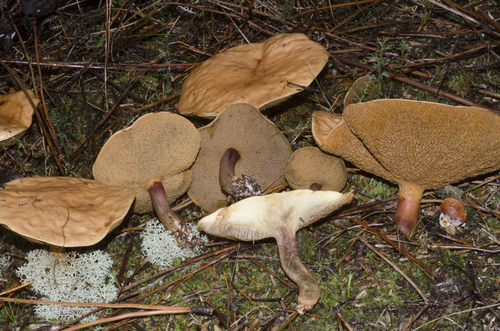
The fungal fruit body, commonly called a mushroom, of Suillus bovinus is a basidiocarp that is smaller and more delicate than most other boletes. The cap is initially convex, later flattening out with a wavy margin. Its colour is grey-yellow or ochre, and some specimens have a pink tinge. Cap diameter ranges from 3–10 cm (1+1⁄4–4 in), and it has a sticky outer skin. The cap flesh is whitish, yellowish, or clay-coloured, and carries a fruity smell. The flesh is spongy and rubbery in texture, and sometimes develops a pink tinge when bruised. Like all other boletes, Suillus bovinus has pores instead of gills that form the hymenophore on the underside of its cap. It has a characteristic two-layered compound pore structure: an outer layer of coarse, angular pores overlays an inner layer of much finer pores. The pores themselves are grey- to olive-yellow, and are generally decurrent. They form yellow to olive-yellow tubes that measure 0.3–1 cm (1⁄8–3⁄8 in) in length. The stipe (stem) grows 4–6 cm (1+1⁄2–2+1⁄4 in) tall, has a similar colour to the cap, and tapers to be narrower towards its base. With a diameter of 0.5–0.8 cm (1⁄4–3⁄8 in), the stipe is more slender than those of most other boletes. The spore print of Suillus bovinus is olive-brown. Its oval to spindle-shaped spores measure 8–10 by 3.5–4.5 μm. Spore-bearing cells called basidia are cylindrical to narrowly club-shaped, measuring 22.4–33.4 by 5.8–8.0 μm. Each basidium bears four sterigmata, each holding one spore, and these structures are up to 6.8 μm long. Cystidia are present both on the ends of the pore tubes (as cheilocystidia) and on the faces of the pore tubes (as pleurocystidia). No clamp connections are present in the hyphae of Suillus bovinus. The cap cuticle is made of filamentous, gelatinized hyphae with a diameter of 2.6–5.0 μm. The fungal mycelium has a pink tinge. The distinctive colour of its cap and pores makes it difficult to confuse Suillus bovinus with other species. The similar-looking species Suillus variegatus often grows in the same habitats, but S. variegatus has a granular cap, smaller dark olive pores that are not decurrent, and its flesh bruises blue.
Suillus bovinus grows in conifer woods and plantations across Europe, including subalpine regions in the Alps up to altitudes of 800 m (2500 ft). It is common in Lithuania, where it forms associations with Scots pine (Pinus sylvestris), the only naturally occurring pine species in that country. This fungus most often prefers acidic, sand-based soils, but it can sometimes be found growing on calcareous (chalky) or moraine soils. In Asia, it has been recorded in Taiwan, in Japan (where it associates with Japanese red pine (Pinus densiflora)), and in the Chinese provinces of Anhui, Fujian, Guangdong, Hunan, Jiangxi, and Zhejiang. Suillus bovinus has been introduced to regions outside its native range. In North America, it is thought to have been introduced alongside planted Scots pine, and occurs in the eastern United States, including North Carolina, Pennsylvania, Vermont, and the Adirondack Mountains of New York. It has been recorded infrequently growing under Scots pine in Australia, where it ranges as far north as southern Queensland, and is also found in more southerly locations including New South Wales and Kuitpo Forest. It has also been recorded in New Zealand. In South Africa, it grows with Pinus radiata.
Suillus bovinus is a mycorrhizal fungus, meaning it forms symbiotic associations with living trees by wrapping the tree's underground roots in sheaths of fungal tissue. Field work studying population structure of Suillus bovinus in Swedish pine forests found that mushrooms are more abundant in younger forests and disturbed forest areas. These areas contain a much higher number of fungal genets (distinct colonies), ranging from 700 to 5700 genets per hectare, compared to only 30 to 120 genets per hectare in mature forest stands. Older colonies in mature forests can reach 17.5 m (57+1⁄2 ft) in diameter, while colonies in young forests are only 1.7–5.3 m (5+1⁄2–17+1⁄2 ft) in diameter. Each spore-bearing mushroom (sporocarp) produces an enormous number of spores: a Finnish study estimated between 240 million and 1.2 billion spores per individual mushroom. Only a very small fraction of these spores successfully grow into new colonies. This very large spore output is thought to explain why there are more colonies in disturbed and young forests, while vegetative spread of existing colonies becomes more important in established forests. Colonies of Suillus bovinus do not overlap, which suggests they suppress the growth of neighbouring colonies of the same species. The median lifespan of a Suillus bovinus colony was estimated to be 36 years. Field work in Swedish pine forests found that Suillus variegatus suppresses the growth of Suillus bovinus, as the two species show a negative correlation in their occurrence. A 1997 Finnish study found that bacterial communities living under Scots pine without mycorrhizae metabolized organic and amino acids, while bacterial communities growing among Suillus bovinus mycelium metabolized mannitol, a sugar alcohol. The Suillus bovinus mycelia also extends the area of soil where these bacteria can grow. An experimental study in Portugal found that Pinus pinaster trees grew better after being inoculated with mycelium from Suillus bovinus, Laccaria laccata and Lactarius deterrimus, and spores from Pisolithus tinctorius and Scleroderma citrinum. These fungi have been proposed as an alternative to chemical fertiliser for arboriculture of pine trees. Suillus bovinus has been shown to improve the tolerance of its host Pinus sylvestris to metal pollutants including cadmium and zinc, though it does not improve tolerance to hazardous organic compounds such as m-toluate. Experimental work conducted in 1986 showed that Suillus bovinus can metabolize proteins and peptides directly, which causes a drop in nitrogen levels in growth media. This suggests the species has some limited saprophytic activity. The related fungus rosy spike-cap (Gomphidius roseus) is found exclusively alongside Suillus bovinus, and is now thought to be parasitic on the mycelium of Suillus bovinus. Evidence for this comes from microscopic examination that shows G. roseus inserts haustoria into tree root cells and does not produce significant mycelium of its own. Additionally, G. roseus is never found growing alone, only in association with Suillus bovinus, while Suillus bovinus is commonly found without G. roseus. The yellow mould Dicranophora fulva has been found growing on decaying Suillus bovinus fruit bodies in Europe and the United States.