About Suillus bellinii (Inzenga) Kuntze
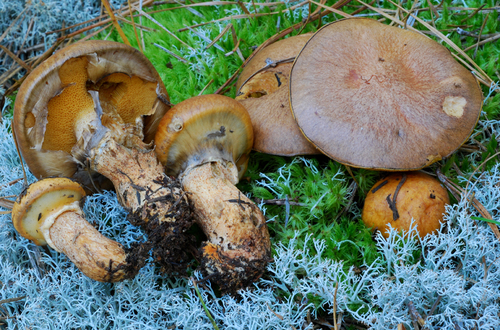
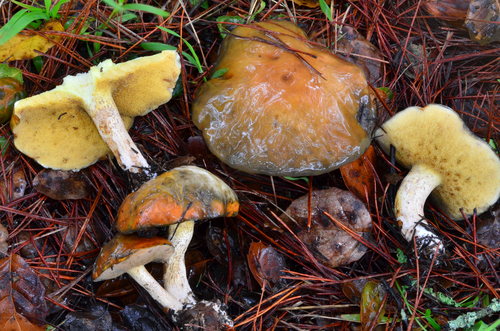
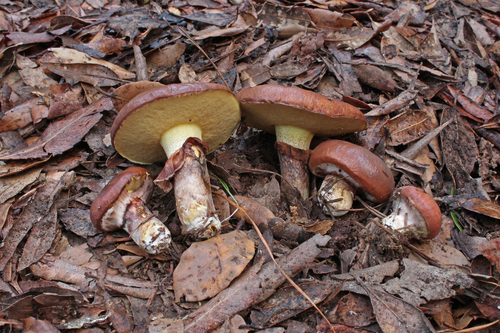
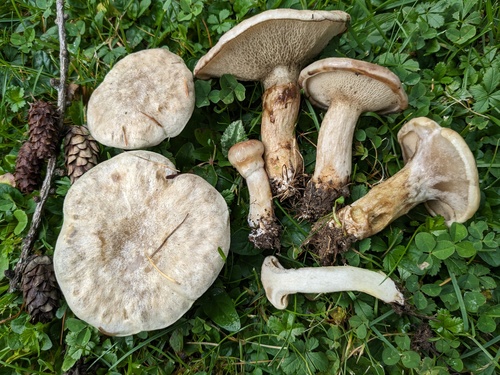
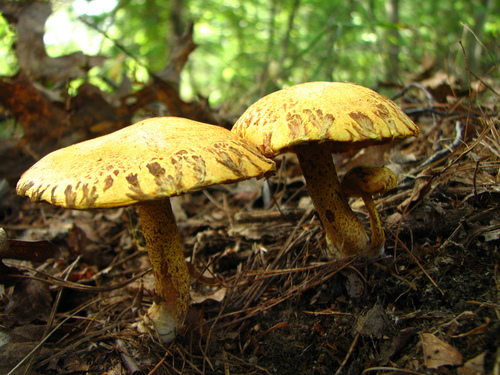
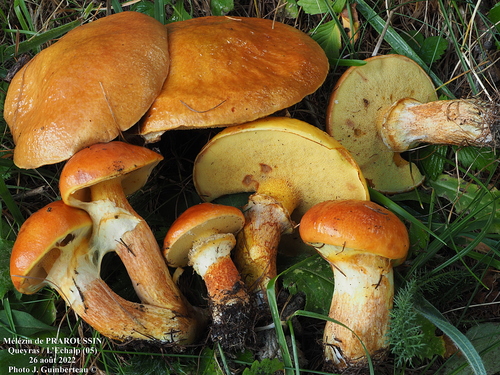
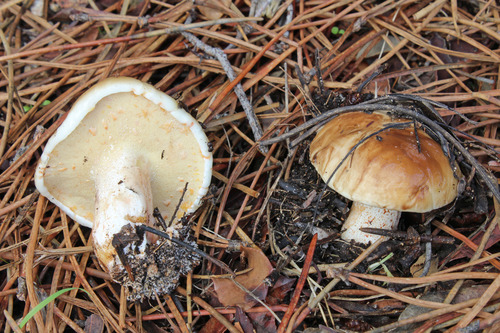
The cap of Suillus bellinii (Inzenga) Kuntze is initially convex and irregular, becoming flatter with maturity, and reaches up to 15 cm in diameter. Its thick cuticle is brown, marbled with white to gray tones toward the periphery, especially in young specimens. Like many other Suillus species, the cuticle is very viscid during wet weather and peels easily. The mushroom has short tubes, and small pores that are whitish or beige when young, turning yellowish with maturity. Fresh specimens may have pores that exude a reddish latex. The stem is short, cylindrical, whitish, and ornamented with reddish dots along its length. The firm flesh is whitish, becoming yellowish at the base of the stem; it is described as having a fruity odor and a pleasant taste, and is often infested with insect larvae. In a color reaction test with ammonia solution, the flesh turns crimson. The spores are ochre-brown, fusiform, and measure 8-10 by 3.5-4.5 μm. Suillus bellinii is a thermophilic fungus that occurs in coastal pine forests in the Mediterranean region of southern Europe. It forms ectomycorrhizal associations with pine species including Aleppo pine (Pinus halepensis), maritime pine (Pinus pinaster), and stone pine (Pinus pinea).