About Suillellus mendax (Simonini & Vizzini) Vizzini, Simonini & Gelardi
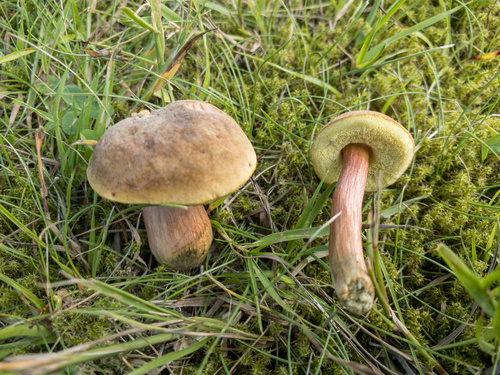
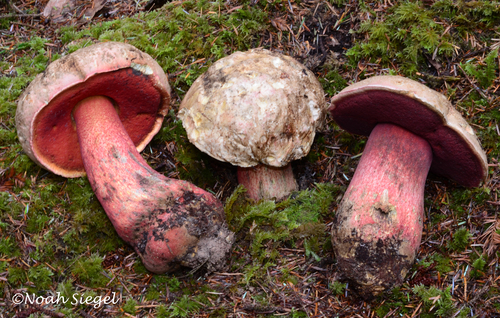
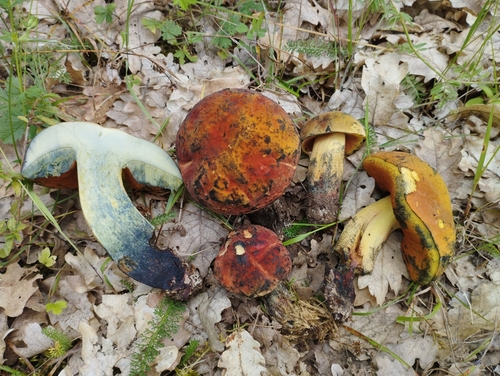
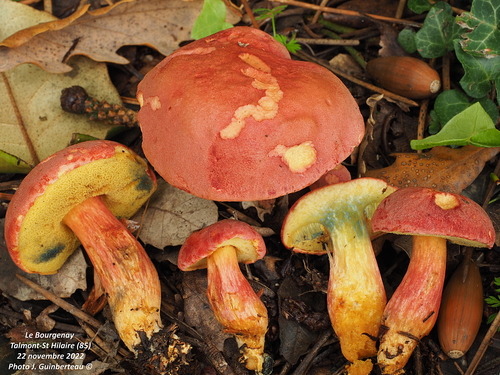
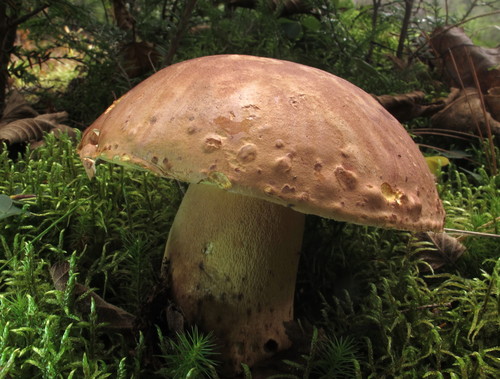
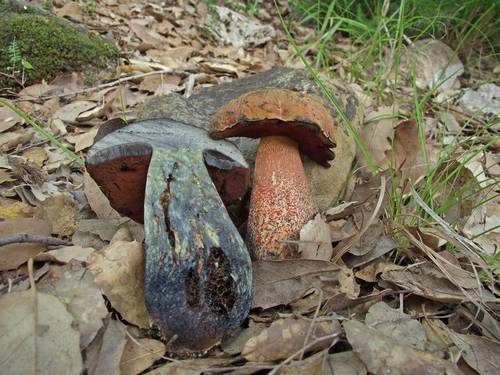
This species has the scientific name Suillellus mendax (Simonini & Vizzini) Vizzini, Simonini & Gelardi. Its fruit bodies produce caps (pilei) 4–12 cm across. Caps start hemispherical to convex, then flatten as they mature, and have a distinctly velvety to tomentose surface. Cap color changes from pale olive-buff in young specimens to deep crimson-red or brownish-red in mature specimens or when conditions are wet. The stipe is 4–12 cm long by 0.8–3 cm thick, with a shape that is cylindrical, slightly swollen, or tapered at the base. It carries a variable net-like reticulation pattern made of crimson lines over an orange-red background. The lower section of the stipe often has fine dark granules or a brown tomentum. The pore surface is made up of small, round pores that are bright yellow when young, quickly turning vivid scarlet-red, and bruise blue when pressed. The flesh is pale yellow, and turns almost immediately indigo-blue when exposed to air. Spore prints of this species are olive-brown. Under microscopic examination, spores are elongated, measuring approximately 13–15 × 5–5.7 μm, and the context at the base of the stipe shows a strong amyloid reaction. Suillellus mendax forms ectomycorrhizal associations with beech (Fagus), oak (Quercus) and sweet chestnut (Castanea). As of current records, it has been molecularly verified to occur in Italy, France, and the island of Cyprus.