About Suillellus luridus (Schaeff.) Murrill
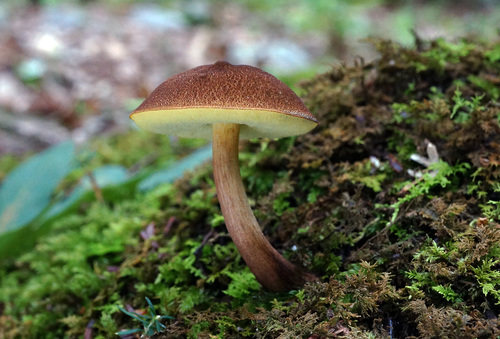
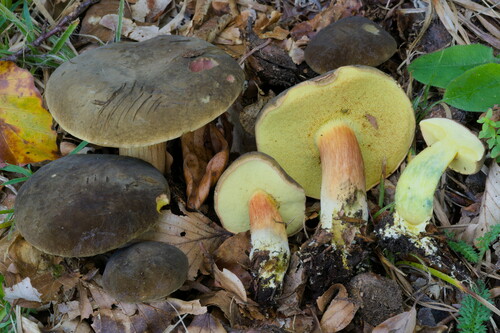
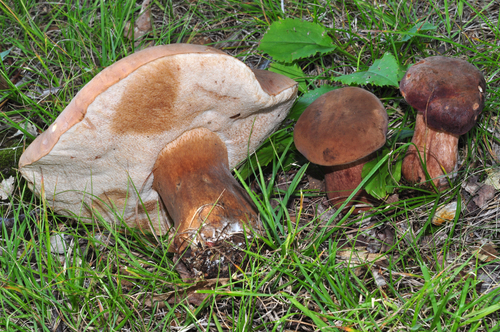
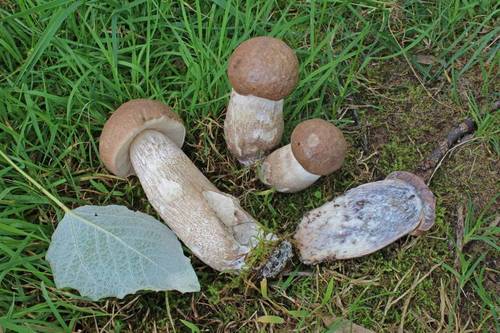
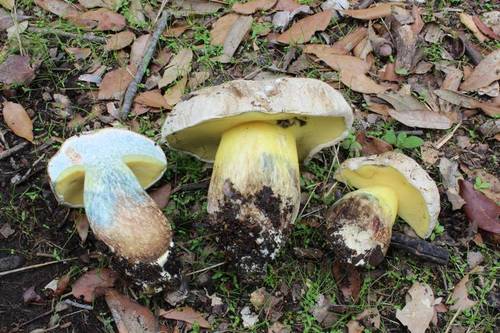
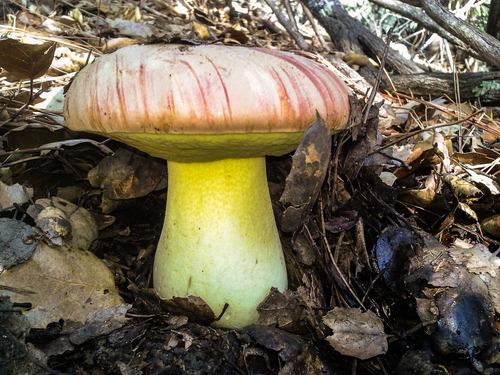
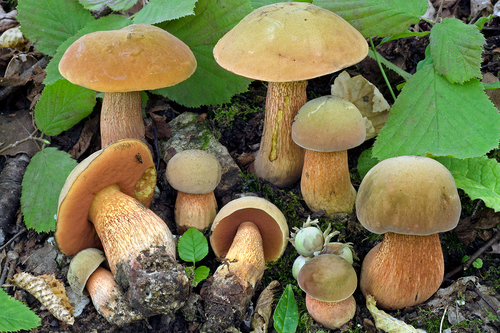
Suillellus luridus (Schaeff.) Murrill is a stout fungus that produces a thick yellow-olive to olive-brown convex cushion-shaped cap, which can reach 20 cm (8 in) across. Cap colour typically darkens as the mushroom ages, and often has patches of red, orange, purple, brown, or olive-green. The cap surface is finely velvety (tomentose) when young, becomes smoother with age, and becomes sticky (viscid) in wet weather. The pore surface is initially yellowish-orange or orange, later turning orange-red, sometimes red, and stains strongly blue when injured or handled. It usually has a lighter-coloured zone around the margin, because pores darken from their stem attachment point outward. There are 2–3 rounded pores per millimetre, and the spore-bearing tubes under the cap are 1–2 cm (0.4–0.8 in) long. Tubes are shorter near the cap margin and close to the stem, where they form a circular depression. Initially pale yellow, tubes gradually become olive-yellow and stain bluish-green when exposed to air. A maroon layer between the tubes and flesh (called Bataille’s line) is a common feature, but it is not always present; the subhymenial flesh can sometimes be yellow or straw-coloured instead. The stem grows 8–14 cm (3–6 in) tall and 1–3 cm (0.4–1.2 in) wide. It has a distinctive elongated orange-red reticulated (net-like) pattern over a paler yellowish, orange, or ochre background, often becoming darker and vinaceous towards the base. The flesh is yellowish, sometimes with red patches in the cap, and almost always rhubarb to vinaceous-red near the stem base. It stains an intense dark blue when bruised or cut. It has a faint sour smell and a mild taste. The mycelium is an unusual yellow colour. Three varieties are recognized: variety queletiformis differs from the main species by having reddish discolouration of the stem base on both the outer surface and the flesh; variety rubriceps has a deep crimson red cap; and var. lupiniformis has a pale yellow or dirty ochre cap and pores, sometimes with pink tones throughout. The spore print is olive to brownish olive. Under a microscope, spores are elliptical to somewhat fusiform (spindle-shaped), measuring 11–15 μm long by 4.5–6.5 μm wide, with a median spore quotient of 2.2. The spore-bearing basidia are club-shaped, four-spored, and measure 29.2–36.5 by 11.0–12.4 μm. Pleurocystidia (cystidia on the tube sides) are fuse-shaped with swollen middles and long necks, measuring 33–48 by 7.3–13.5 μm; cheilocystidia on the pore edges have the same shape. The cap cuticle is made of compactly interwoven cylindrical hyphae 3.7–5.8 μm wide, with erect hyphal tips grouped in bundles. The hyphae of the cap flesh are loosely interwoven, cylindrical, branched, and measure 3.7–8.8 μm. No clamp connections are present in the hyphae. Several chemical tests can help identify this species. A drop of dilute potassium hydroxide on the cap cuticle stains it dark red to blackish, and stains the flesh orange-yellow. Ferrous sulfate solution turns the cap cuticle yellow, then greenish-yellow. After the natural bluing reaction from injury fades, Melzer's reagent turns the flesh dark blue. This fungus forms mycorrhizal associations with broad-leaved trees including oak (Quercus), birch (Betula), chestnut (Castanea) and beech (Fagus), growing on chalky (calcareous) soils. In the Czech Republic, variety rubriceps has been recorded growing under linden (Tilia). It is also suspected to form mycorrhizal associations with subshrub rock roses of the genus Helianthemum. Field studies show that when S. luridus forms a mycorrhizal partnership with seedlings of the conifer Cunninghamia lanceolata, it increases the seedling survival rate, boosts height and ground diameter, and raises leaf chlorophyll content. A similar growth-enhancing effect was previously recorded for Pinus taiwanensis seedlings. These beneficial effects on plant growth come from multiple interactions between the fungus, host plant, and native soil microbes, which increase carbon biomass and bacterial diversity in the mycorrhizosphere. In a study comparing salinity tolerance among three common ectomycorrhizal fungi (the other two were Suillus bovinus and S. luteus), S. luridus was the most tolerant to high salt concentrations, making it a good candidate for inoculating tree seedlings intended for planting on saline soil. Fruit bodies grow singly or scattered on the ground from June to November after summer rains. S. luridus may grow in parks near a single tree, and it is very rarely found in acidic soils. 19th-century British mycologist Anna Maria Hussey noted that insects heavily favour this mushroom; she wrote in 1847 that few soft-fleshed fungi (which are hosts to many insects) are as favoured as this species (then called poisonous Boletus luridus): breaking open an old specimen reveals a living mass of larvae. It is attacked so quickly by insects that it is very rare to find specimens without wriggling larvae. Since it is very common and abundant, it plays an important role supporting insect populations. Several fly species have been recorded feeding on the fruit bodies, including Phaonia boleticola, P. rufipalpis, Thricops diaphanus, and in North America, Drosophila falleni, Pegomya mallochi, P. winthemi, Megaselia pygmaeoides, and Muscina assimilis. Slugs, by contrast, tend to avoid eating this species. Based on phylogenetically verified collections and underground DNA studies of mycelial distribution, this fungus is native to Europe and has been confirmed present in Austria, Cyprus, Denmark, Estonia, France, Italy, Montenegro and Sweden. Its range may extend east to the Black Sea and eastern Anatolia regions of Turkey, and south to Bar'am Forest in the Upper Galilee region of northern Israel, though these records require molecular confirmation. Many extra-European records appear in pre-DNA study literature, ranging from India and Pakistan to Canada, the United States, Mexico, Costa Rica, China and Taiwan, but these have not been confirmed by molecular testing and are more likely to be similar, misidentified species. With a mild taste, Suillellus luridus is often reported to be edible when thoroughly cooked. It is highly regarded in France, and commonly eaten in Italy, the Czech Republic, Slovakia and other parts of Europe. However, caution is recommended when collecting this species for eating, since it resembles some poisonous blue-staining boletes, and some field guides recommend avoiding it entirely. If eaten raw or undercooked, it can cause gastrointestinal poisoning symptoms within 30 minutes to two hours, including nausea, vomiting, abdominal cramps, and diarrhoea. Full recovery can be expected within 24 to 48 hours if fluid losses are replaced. Suillellus luridus has been suspected of causing increased alcohol sensitivity similar to that caused by common ink cap (Coprinopsis atramentaria), along with gastric symptoms. A German mycologist reported experiencing symptoms himself after drinking alcohol while eating this "otherwise excellent" mushroom. A 1982 report of three cases from Switzerland further suggested the species was responsible, but a 1994 study casts doubt on this conclusion. Researchers Ulrich Kiwitt and Hartmut Laatsch tested for the antabuse-like compound coprine in S. luridus and similar species, and found no coprine in this suspected species, but did find evidence of coprine in the rare Imperator torosus. They concluded that historical incidents were most likely due to misidentifying Imperator torosus as S. luridus, though they could not rule out S. luridus containing an as-yet-unidentified compound that causes alcohol-related reactions.