About Suillellus amygdalinus (Thiers) Vizzini, Simonini & Gelardi
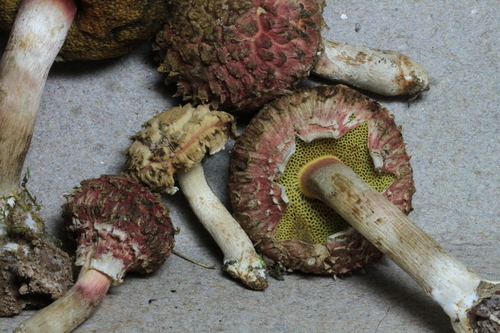
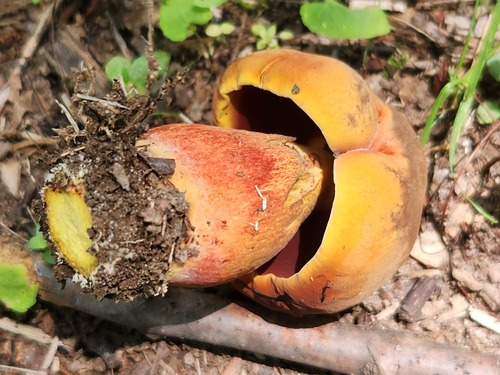
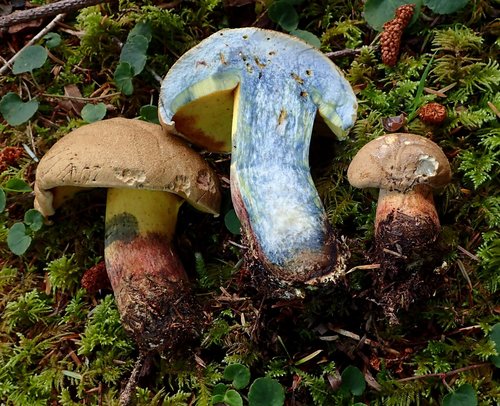
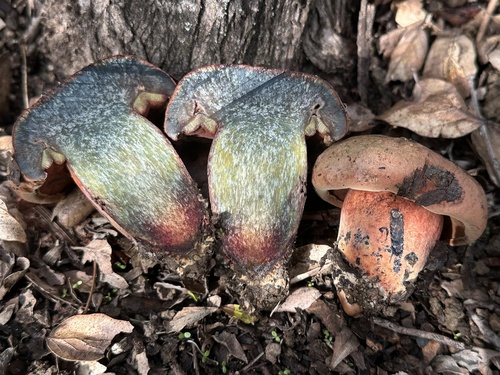
Suillellus amygdalinus is a large solid mushroom with a convex to somewhat flattened, irregular cap that reaches 6 to 12 cm (2.4 to 4.7 in) in diameter at maturity. The cap surface is dry and matted with fibers. Young specimens have a red cap, which typically shifts to more brownish tones as the mushroom matures. The cap margin starts incurved (curved inwards) and gradually becomes decurved (curved downwards) with age. The pores on the underside of the cap are 0.5 to 1 mm (0.02 to 0.04 in) wide, angular, and red or red-orange, while the tubes that hold the pores are 1 to 1.5 cm (0.4 to 0.6 in) deep. The stipe has no reticulation (netted pattern), is yellow in color, and is often covered by red hairs, especially near the base. It is either equal in width throughout its length or thicker in the middle, and reaches 4–9 cm (1.6–3.5 in) long by 1–3 cm (0.4–1.2 in) thick. The base of the stipe is typically bent. The flesh is 1 to 2 cm (0.4 to 0.8 in) thick, yellow in color, and like all parts of the mushroom, stains blue immediately after bruising or cutting. Fruit bodies have mild odor and mild taste. Microscopically, Suillellus amygdalinus produces a dark olive-brown spore print. Its spores are thick-walled, smooth, and ellipsoid to somewhat spindle-shaped, with dimensions of 11.2–16 by 5.2–8 μm. Spores turn dark ochraceous when stained with Melzer's reagent, and may appear two-celled due to the occasional presence of two large vacuoles. The spore-bearing basidia are club-shaped, contain numerous vacuoles, and measure 30–35 by 9–11 μm. Cystidia are present on the sides of the tubes, measuring 45–54 by 10–12 μm. Clamp connections are absent from the hyphae of S. amygdalinus. Several chemical color tests can help identify suspected S. amygdalinus fruit bodies. A drop of dilute potassium hydroxide (KOH) turns the cap flesh dingy orange, and turns the cap cuticle red or darker. Ammonia (as ammonium hydroxide, NH4OH) produces a dingy yellow color on the flesh, and brown on the cap. Iron sulphate (FeSO4) produces either no change or a pale grey color on both the flesh and the cuticle. Hydrochloric acid (HCl) causes the flesh to turn orange or pink, but does not produce a color reaction with the cuticle. Suillellus amygdalinus mushrooms grow on the ground, either in scattered groups or as isolated individuals. The fungus has been recorded in low-elevation hardwood forests made up of live oak, manzanita, and madrone in California and Oregon. Fruiting occurs after the start of autumn rains, usually between October and January. The mushroom can be hard to spot: its cap has a similar color to madrone tree leaves, which it associates with, and it is often buried under fallen leaves.