About Sublegatus arenarum (Salvin, 1863)
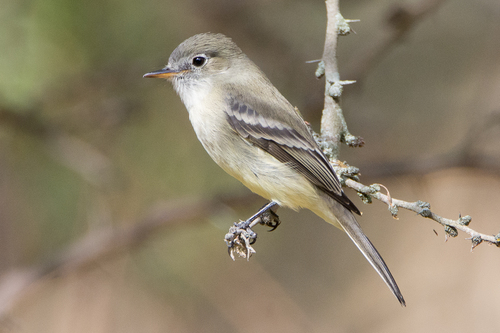
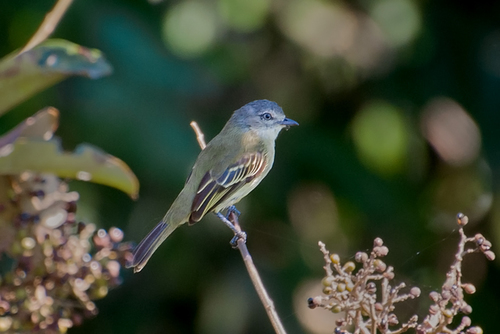
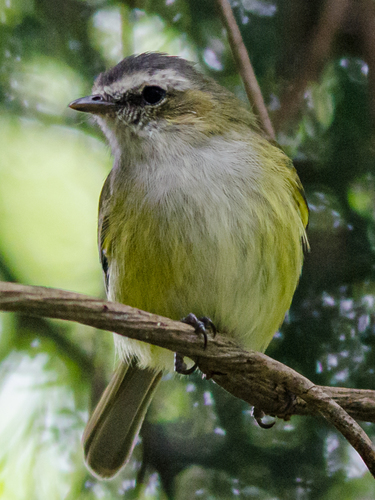
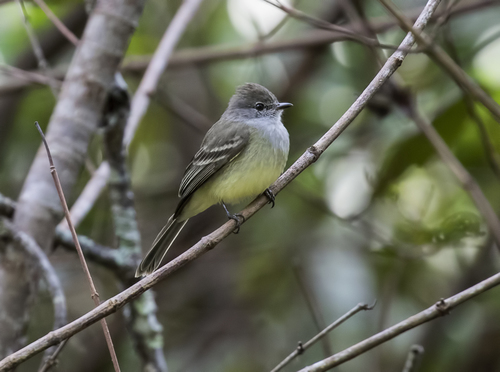
The northern scrub flycatcher (scientific name Sublegatus arenarum, first described by Salvin in 1863) measures 13 to 15 cm (5.1 to 5.9 in) in length and weighs 10.5 to 15 g (0.37 to 0.53 oz). Males and females have identical plumage. Adults of the nominate subspecies S. a. arenarum have a grayish brown crown that can sometimes be raised into a shaggy crest. Their face is mostly whitish to pale gray, with a whitish supercilium, a dark line running through the eye, and darker gray coloring toward the back of the ear coverts. Their back and rump are grayish brown. Their wings are dusky gray, with paler grayish to whitish edges on the flight feathers and whitish to pale grayish tips on the wing coverts; these tipped coverts form two distinct wing bars. Their tail is dusky, with white tips on each feather. Their chin is whitish, their throat and breast pale gray, and their belly medium yellow, with a sharp boundary between the gray breast and yellow belly. All subspecies have a dark brown iris, a short thick black bill, and gray legs and feet. Juveniles have a similar appearance to adults. The other recognized subspecies differ from the nominate subspecies and from each other in the following ways: S. a. glaber is larger than the nominate, with darker olive-brown upperparts and duller whitish to buff wing bars. S. a. atrirostris has paler gray-brown upperparts, a duller white throat, and paler gray breast and flanks than the nominate. S. a. pallens is slightly smaller and paler gray on the upperparts than S. a. atrirostris, with a whiter throat and breast. S. a. tortugensis has an even whiter throat than S. a. pallens, and is otherwise identical to that subspecies. S. a. orinocensis is the smallest and palest subspecies. The northern scrub flycatcher has a discontinuous, split distribution, with each subspecies occupying a separate range as follows: S. a. arenarum is found around the Gulf of Nicoya in northwestern Costa Rica, Golfo Dulce in southwestern Costa Rica, along the Pacific slope of Panama intermittently extending to western Darién Province, and on Coiba Island and the Pearl Islands off western Panama. S. a. atrirostris is found in northern Colombia, from the departments of Sucre and Bolívar north to La Guajira Department. S. a. glaber occurs in northern Venezuela from Zulia state east to Sucre state, on Venezuela's Margarita Island, Patos Island, and Los Roques Archipelago, on Trinidad and its adjacent small islets, and along the coasts of Guyana, French Guiana, and Suriname. S. a. tortugensis is found only on Venezuela's La Tortuga Island. S. a. pallens occurs on Aruba, Bonaire, and Curaçao. S. a. orinocensis is found in the Orinoco River valley, from eastern Meta Department in Colombia east into western Venezuela, and extends intermittently further east into northern Bolívar state in Venezuela. The northern scrub flycatcher lives in a range of different landscape types. Most subspecies are found in mangroves and nearby scrubby vegetation. S. a. glaber is found in mangroves and scrub, and also in cactus stands, deciduous thorn woodlands, and desert. S. a. atrirostris and S. a. orinocensis are found mostly in dry woodlands and scrubby second growth. Across the species' entire range, it occurs from sea level up to approximately 600 m (2,000 ft) in elevation.