About Suastus gremius (Fabricius, 1798)
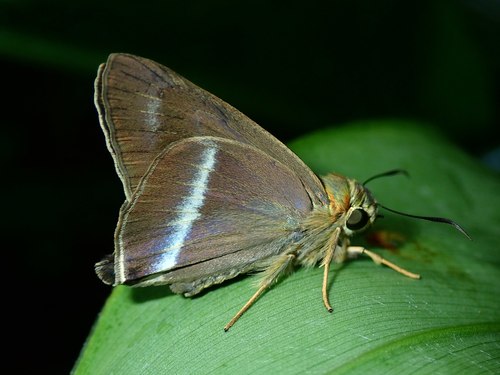
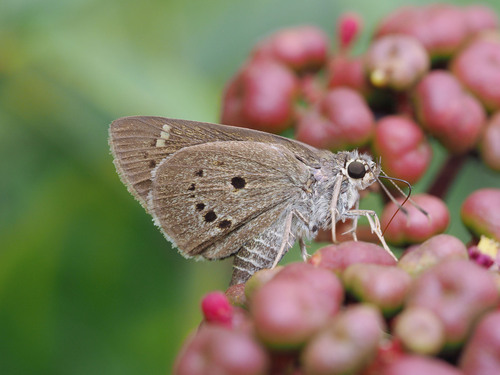
Description of the male: Upperside is olive-brown. The forewing has ochreous-white spots: one small spot in the middle of the discocellulars, sometimes a minute spot above it, and three small sub-apical spots (the uppermost is usually minute). Three larger discal spots form an oblique line: the uppermost sits before the middle of the first median interspace, the second (somewhat oval) also sits before the middle of the first median interspace, and the third (a long oval) sits a little beyond the middle of the interno-median interspace. These discal spots vary a great deal in size. The hindwing is paler than the forewing, has a broad dark costal margin, and lacks any markings. Cilia on both wings are brownish-ochreous. The underside is grey with a pinkish tinge. On the forewing, the inner portion below the subcostal vein is suffused with black, leaving the apex broadly pinkish-grey, and the spots match those seen on the upperside. The hindwing is clear pinkish-grey with no suffusion, but is sparsely covered in whitish scales. It has a black spot near the upper end of the cell, and three black spots in an oblique row across the median and interno-median interspaces; all black spots are ringed with whitish. Antennae are black, with an orange club tip; the underside of the club and shaft is whitish. The head and body are brown on the upper side, and grey on the underside. Legs are grey, with orange tarsi. Females are usually paler than males, with similar markings, but all spots on the forewing are larger. The two upper discal spots are square, the middle spot has an excavated outer side, and there are two conjoined large spots at the cell end. Females are generally (but not always) somewhat larger than males.