About Suaeda maritima (L.) Dumort.
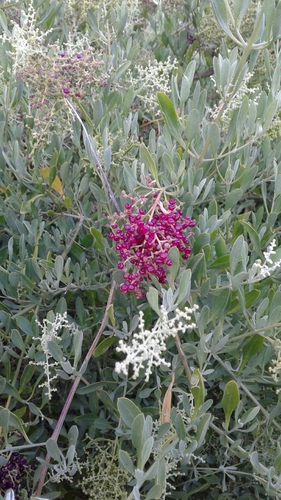
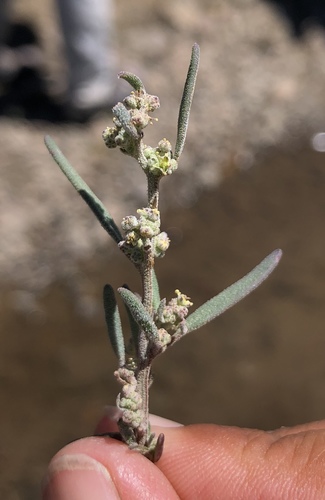
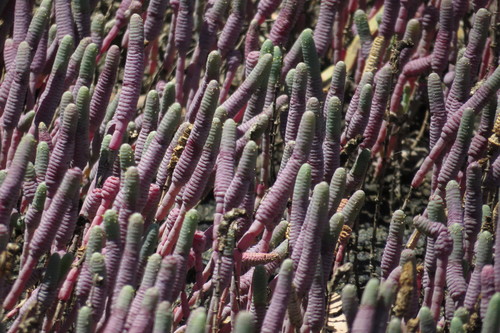
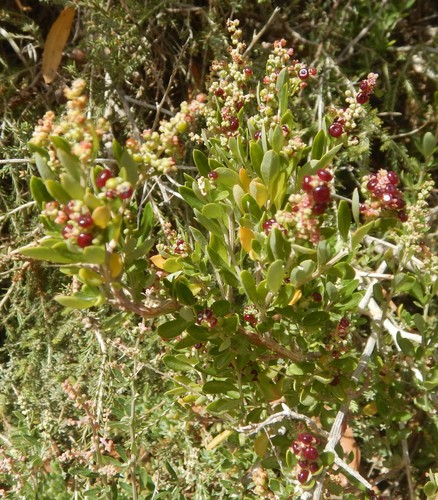
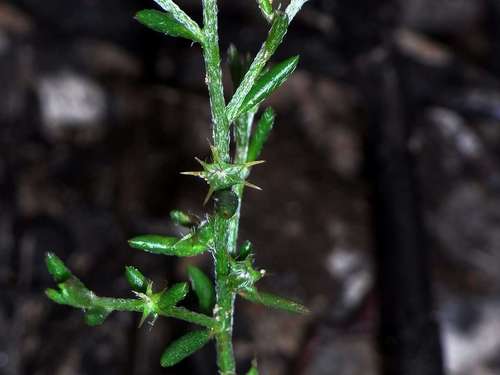
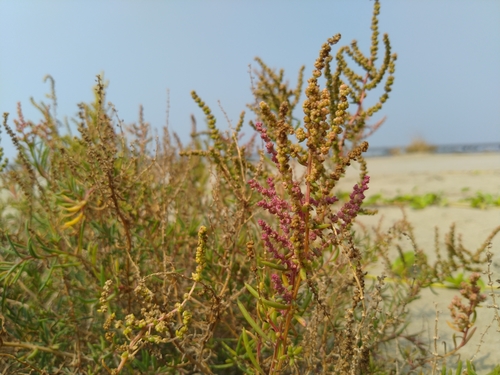
Suaeda maritima (L.) Dumort. is a yellow-green shrub with fleshy, succulent leaves and green flowers. It grows to about 35 cm (14 in) tall in salt marshes. It is found worldwide, and in North America it occurs primarily on the northern east coast. In New England, the introduced subspecies is S. maritima ssp. maritima, while the native subspecies is S. maritima ssp. richii. This native New England subspecies appears on endangered and rare plant lists: it is classified as rare in Massachusetts, and extremely rare (S1) in Maine, New Hampshire and Rhode Island, where it is protected and disturbance is prohibited. This species occupies aquatic, terrestrial, and wetland habitats, but occurs mainly in salt marshes and sea shores, usually growing below the high water mark. Suaeda maritima can trap mud and help accumulate sediment to build up salt marshes. The life cycle of Suaeda maritima is primarily annual: the plant completes its entire life cycle from seed to flower to seed within a single growing season. All roots, stems, and leaves die at the end of the growing season, and only dormant seeds persist to bridge generations between growing seasons. There are currently no known documented medical uses for this plant. As noted earlier, where the native subspecies is protected, harvest or disturbance of this plant may be prohibited. This plant, also called sea blite, is edible; its young leaves can be eaten raw or cooked, and have a strong salty flavor. The seeds can also be consumed raw or cooked. Due to its naturally high salt content, it can be used as a seasoning when combined with other foods. The ashes of sea blite have been used to make a material used in soap and glass production.