About Styphelia nesophila (DC.) Sleumer
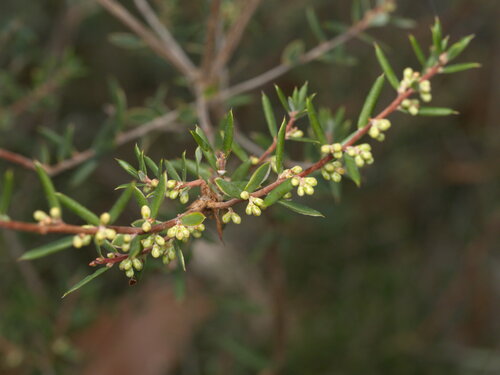
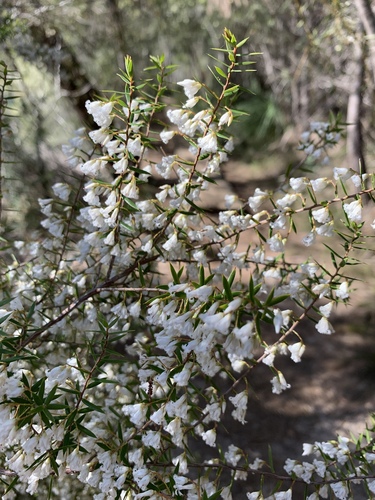
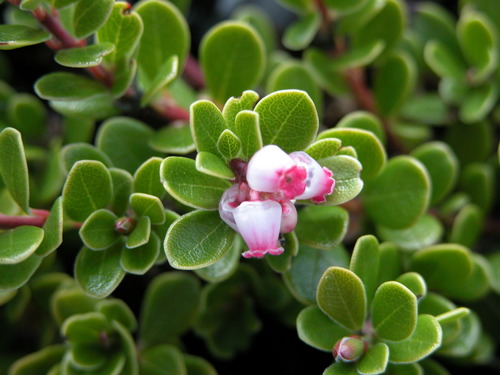
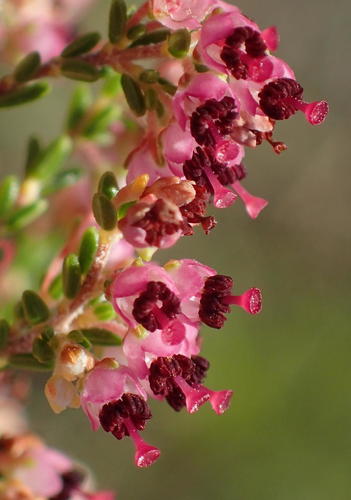
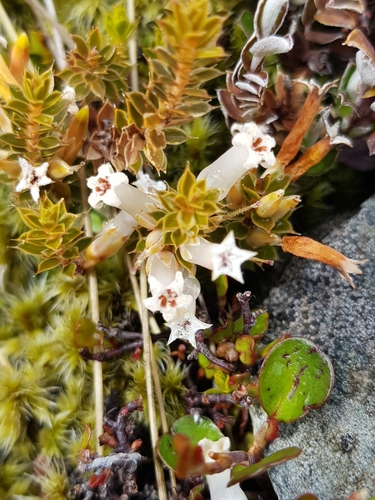
Styphelia nesophila is a prickly, prostrate to trailing, low-growing shrub that typically reaches a maximum height of 30 cm (12 in), and it has bristly branchlets. Its leaves are egg-shaped to lance-shaped, with the narrower end positioned toward the base, and measure 3–8 mm (0.12–0.31 in) long and 1–2.5 mm (0.039–0.098 in) wide. The leaves are glabrous with pale edges, and bear a thin, sharp point up to 1.5 mm (0.059 in) long at the tip. Flowers are usually arranged singly in leaf axils on a peduncle approximately 1 mm (0.039 in) long, with 1.1–1.8 mm (0.043–0.071 in) long bracteoles at the base. The sepals measure 2.5–3.9 mm (0.098–0.154 in) long. The petals form a tube 4–5 mm (0.16–0.20 in) long that is hairy on the inside, and the petal lobes are 2.0–3.4 mm (0.079–0.134 in) long. Flowering takes place from August to October, and the fruit is a glabrous, yellow, egg-shaped to elliptic drupe 4.7–5.3 mm (0.19–0.21 in) long. This species grows in forest, shrubland and heath, most often in poorly-drained or sandy soils or among rocks, and it usually occurs at altitudes above approximately 500 m (1,600 ft). It can be found on the tablelands of northern and southern New South Wales, in eastern Victoria, on the Central Plateau of Tasmania, and in New Zealand. The fleshy fruits of Styphelia nesophila are dispersed via frugivory.