About Styphelia neoanglica (F.Muell. ex Benth.) F.Muell.
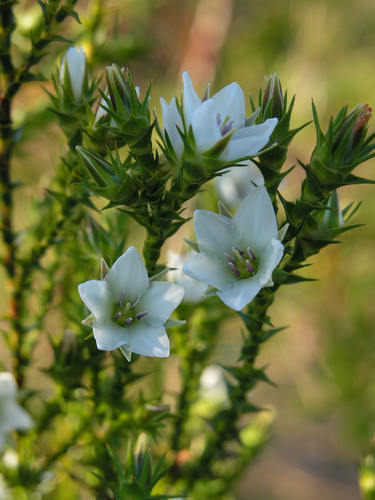
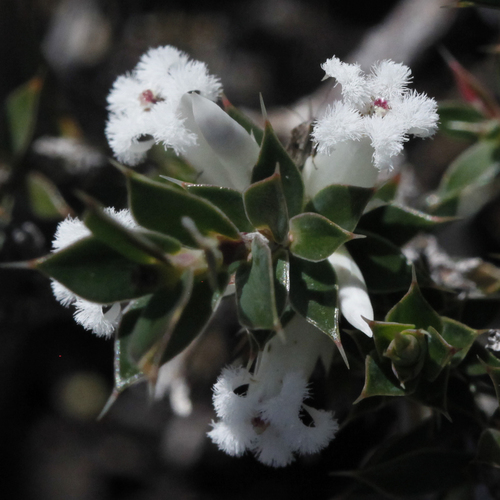
Styphelia neoanglica, commonly called New England beard-heath, is an erect shrub that usually reaches a maximum height of 80 cm (31 in). Its branchlets have a rough texture. The leaves are broadly egg-shaped to egg-shaped with the narrower end at the base, measuring 5.6–10.3 mm (0.22–0.41 in) long and 2.3–4.6 mm (0.091–0.181 in) wide, borne on a petiole roughly 0.3 mm (0.012 in) long. The leaves are hairless, with 3 parallel veins running through the centre and other veins spreading outward. Flowers are erect, arranged in leaf axils, with 1.8–2.9 mm (0.071–0.114 in) long bracteoles at their base. Sepals are 3.9–5 mm (0.15–0.20 in) long. The petals are white, joined at the base to form a tube 5.0–7.7 mm (0.20–0.30 in) long, with 3.7–4.5 mm (0.15–0.18 in) long lobes that are bearded on the inside. Flowering takes place from March to October. The fruit is a hairless, reddish-brown elliptic drupe that is roughly 3.2 mm (0.13 in) long. This species typically grows in sandy soil on rocky outcrops, occurring on the coast and nearby tablelands at altitudes up to 600 m (2,000 ft). Its range extends from south-east Queensland to the Budawang Range in south-eastern New South Wales.