About Styphelia humifusa (Cav.) Pers.
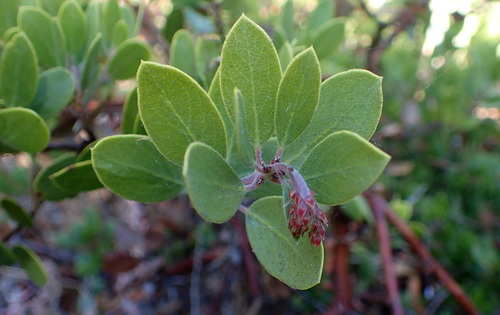
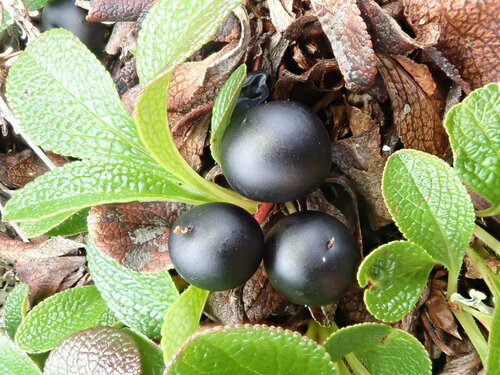
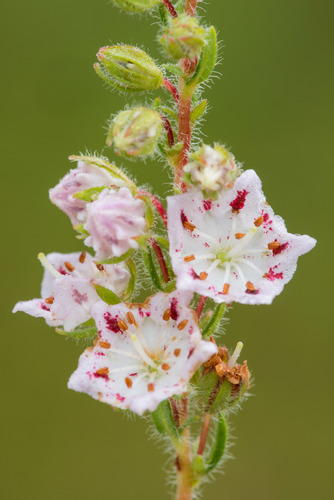
Styphelia humifusa (Cav.) Pers. is a spreading, mat-like shrub that reaches up to 50 cm (20 in) in height and 0.5 to 1.5 m (20 in to 5 ft) across. Its hairy stems carry blue-green, pine-like, pointed leaves that measure 0.5–1.2 cm (0.2–0.5 in) long. The tubular flowers, which grow up to 2 cm (0.8 in) long, bloom from February to June. All flowers of this species are solid red, unlike the red and green flowers of A. pinifolium. After flowering, the plant produces green, round berries around 0.4–0.6 cm (0.2 in) in diameter, which turn reddish when they ripen.
This species is native to southeastern Australia. Its range extends from Port Stephens in northern eastern and central New South Wales, through Victoria, into southeastern South Australia, and also includes Tasmania. It most commonly grows in open woodland on sandstone and clay soils, and can also be found in upland bogs. Known associated plant species include Eucalyptus fibrosa, Eucalyptus sideroxylon, and Kunzea ambigua.
In ecological terms, the eastern bettong (Bettongia gaimardi) eats the fruit of Styphelia humifusa. For cultivation in gardens, this species requires good drainage and can be grown in rockeries. Its juicy berries are edible, though most of the berry is occupied by a large seed. The berries can be used to make jams or preserves, and their flavour has been described as "sickly sweet". The 1889 book The Useful Native Plants of Australia records that "The fruits of these dwarf shrubs have a viscid sweetish pulp, with a relatively large stone. The pulp is described by some as being "apple flavoured..."