About Styphelia esquamata (R.Br.) Spreng.
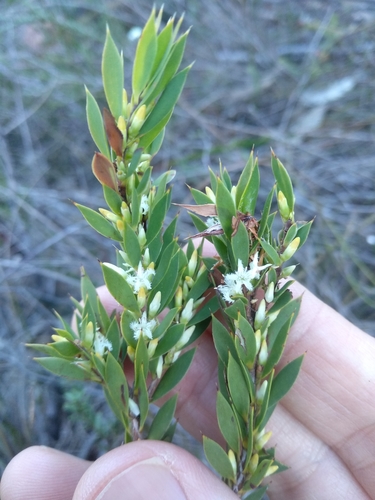
Styphelia esquamata (common name swamp beard-heath) is an erect, leafy shrub that typically grows to a height of 0.2–1 m (7.9 in – 3 ft 3.4 in), and has hairless glabrous branchlets. Its leaves are erect, and range in shape from elliptic to narrowly elliptic, sometimes egg-shaped with the narrower end towards the base. The leaves measure 7–15 mm (0.28–0.59 in) long and 2.0–3.3 mm (0.079–0.130 in) wide, and grow on a petiole about 1 mm (0.039 in) long. The lower surface of the leaves is paler than the upper surface and is faintly striated, and the leaf edges have minute teeth near the tip.
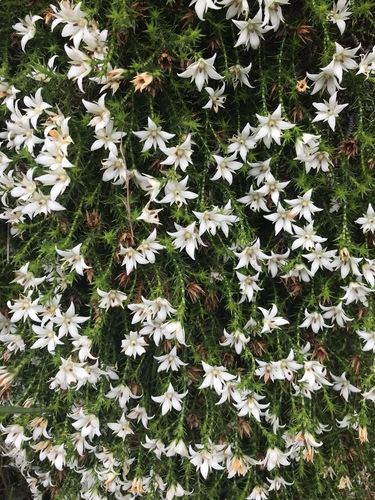
The flowers are white, arranged singly or in pairs in upper leaf axils. They grow on an erect peduncle up to 1.5 mm (0.059 in) long, with bracteoles 1.2–1.5 mm (0.047–0.059 in) long at the base. The sepals are egg-shaped and 2.1–2.5 mm (0.083–0.098 in) long. The petal tube is 1.0–1.5 mm (0.039–0.059 in) long and densely bearded inside, and the petal lobes are 2.3–2.9 mm (0.091–0.114 in) long. Flowering occurs in August and September, and the fruit is a glabrous, brown, cylindrical drupe 3.8–4.5 mm (0.15–0.18 in) long.
This species most commonly grows in swampy heath, and sometimes grows in forest or at the base of sandstone cliffs. It is found in New South Wales south from Brooms Head near Angourie, extending to poorly-drained near-coastal heath as far west as Marlo in north-eastern Victoria. It also grows on sandy headlands on Flinders and Cape Barren Islands in Tasmania.