About Styphelia adscendens R.Br.
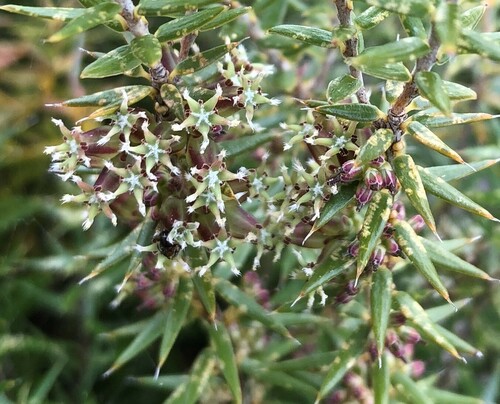
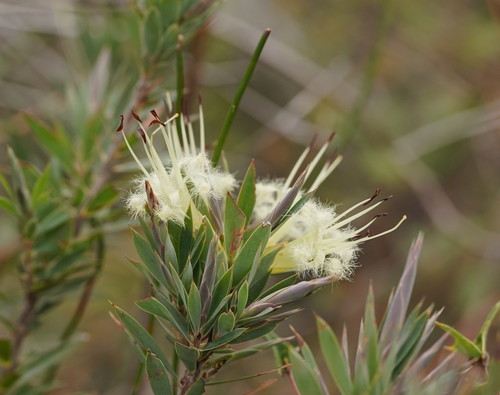
Styphelia adscendens, commonly called golden heath, is a prostrate or low-lying shrub that usually reaches a maximum height of around 60 cm (24 in). Its branchlets are covered with soft hairs. The leaves are lance-shaped, sometimes obovate (with the narrower end towards the base), 7–32 mm (0.28–1.26 in) long, 1.8–6.5 mm (0.071–0.256 in) wide, and often slightly twisted. The flowers are erect, borne singly or in pairs in leaf axils. They are accompanied by lance-shaped bracts that are 1–3.5 mm (0.039–0.138 in) long, and bracteoles that are 3–6 mm (0.12–0.24 in) long. The flowers themselves are erect, and may be cream-coloured, pale yellowish-green, or reddish. Sepals measure 7–13.5 mm (0.28–0.53 in) long. Petals form a tube 12.5–20 mm (0.49–0.79 in) long, with bearded lobes 13–17.5 mm (0.51–0.69 in) long. Stamen filaments are 11–14 mm (0.43–0.55 in) long, and the style is 26–38 mm (1.0–1.5 in) long. Flowering takes place from June to December. The fruit is oval, slightly lobed, and 4.3–8.5 mm (0.17–0.33 in) long. Golden heath grows in scrub, woodland, and forest. Its distribution extends from south of Nerriga in New South Wales, through eastern and western Victoria, far south-eastern South Australia, and Tasmania.